Showing posts with label charlemagne. Show all posts

Saturday, January 25, 2020

The Carolingian Renaissance

Apart from the effect Charlemagne had on politics, education and literacy in general, art, architecture -- you must take a look at the Palace of Aachen if you're ever in the area -- and the beginnings of German literature, his impact on Classical studies was immense. Here is a list, given by LD Reynolds in the introduction to Texts and Transmission, 1983, p xxviii, of authors and anonymous works of the Latin Classics for which we possess 9th-century manuscripts:

Agrimensores, Ammianus, Apicius, Apuleius, Aratea, Ausonius, Avianus, Caelius, Aurelianus, Caesar, Celsus, Censorinus, Charisius, Cicero, Claudian, Columella, Curtius Rufus, Donatus, Eutropius, Faventius, Florus, Frontinus, Gellius, Grattius, Historia Augusta, Horace, Hyginus, Justinus, Juvenal, Livy, Lucan, Lucretius, Macrobius, Martial, Martianus Capella, Pomponius Mela, Nemesianus, Nonius Marcellus, Notitia dignitatum, Ovid, Palladius, Julius Paris, Persius, Petronius, Phaedrus, the Elder and Younger Pliny, Publius, Querolus, Quintilian, Rhetores latini minores, Rhetorica ad Herennium, Sallust, the Elder and Younger Seneca, Q Serenus, Servius, Solinus, Statius, Suetonius, Tacitus, Terence, Valerius Flaccus, Valerius Maximus, Vergil, Vibius Sequester and Vitruvius.

And, as Reynolds points out ibid, there were once even more 9th century manuscripts, which the 15th-century Humanists discovered and then lost. And it may be that still more 9th-century manuscripts have come to light since 1983, I'm not sure. Compare this with the 7th century, from which survives (ibid, p xvi) a fragment of Lucan as the solitary Classical artifact.

Some lists of manuscripts have more significance than others. The above list shows how one monarch transformed the study of Classical Latin, because almost all of the 9th-century manuscripts in that list were made in monasteries and school either newly built or rejuvenated, mostly the former, on Charlemagne's orders.

Countless Classical scholars over the past 1200 years have been immensely grateful for the Carolingian minuscule, the form of handwriting developed in Charlemagne's time which has made reading those 9th-century manuscripts so much easier than so many manuscripts written both earlier and later.


All of this makes Charlemagne's own case more poignant: although he was said to have spoken Latin, Arabic and Greek in addition to his native German -- which may seem less farfetched to you when consider that his empire bordered on Arab-controlled Spain to the south-west and Greek Byzantium to the east -- he never quite mastered writing. Einhard describes how, late in his life, he did his writing lessons in bed before going to sleep, but never did quite get the hang of it. Some people don't believe Einhard's description. To me it rings true. I suppose the question must remain unsolved for now.

Another question which can't be answered, in part because it's difficult to quantify, is, which single person has done the most to rescue the literature of ancient Rome. Some have said Cassidorius. Others have said Poggio, but we know that those people are half-educated bozos. Perhaps I'm biased, perhaps I've been taken in by by the lingering effects of some medieval legends, but to me, it's always seemed clear that it was Charlemagne.

Thursday, July 11, 2019

We Are Not All Descendants of Charlemagne, or Nefertiti

I've been looking and looking for someone who has refuted the notion that all Europeans are descended from Charlemagne,


or that all living humans are descended from Nefertiri. To my great frustration, I can't find anyone pointing out that this is nonsense. Once again, I must do everything myself.

And I don't have any training whatsoever in biology. But I think I don't need any, because I have much more than enough knowledge of history.

First of all, what does "all Europeans" mean, scientifically? It means nothing. How can you precisely determine who is and who is not a European? You can't. Ditto for African, Asian, Native American and so forth.

Secondly, the assertion that we all share ancestors who lived as little as 4000 years ago drastically, massively underestimate the amount of isolation, xenophobia and, consequently, inbreeding among many human groups. I'm referring to people in remote villages who drive off any and all furrners just as well as they possibly can, but also, for instance, the European royal family, and yes, it is one, horribly inbred family, and has been for many centuries. Not "every European" is descended from Charlemagne, but every European monarch -- a group which can be precisely defined -- is descended from Charlemagne, and every European monarch for centuries has been. Meghan, Duchess of Sussex, is a radical departure from royal custom, and an extremely healthy expansion of that bottlenecked gene pool.

Now let's take the matter of geographical isolation. This really ought to be enough to let everyone see that the assertions that all living human beings share ancestors when you go back less than 5000 years, are badly mistaken.

Ladies and gentlemen, I present Exhibit A: the Western Hemisphere. Yes, genetic blending of the Eastern and Western Hemispheres has been going on for -- over 500 years. Is that enough to guarantee that every single living human being shares an ancestor less than 5000 years old? No. There may be some tribes in the Amazon which people from other parts of the world haven't found yet. There certainly were as few as several decades ago. Several decades is not enough to have gotten all of them into the mix, genetically.

Exhibit B: Australia. Stumbled across by Captain Cook in 1770. Have 249 years been enough to guarantee that there is no-one of unmixed Aborigine heritage left alive? No!

Like I said, it frustrates me greatly that I need to do this, that there aren't actual geneticists everywhere you look pointing out such elementary things with the proper scientific jargon. It's very frustrating that it has to be me, completely lacking the apprpriate vocabulary, grunting things like "Amazon forest tribes! Australia, goddamit! There's no such thing as Europeans or Asians! Aaaaaarrrgghh!"

Wednesday, June 27, 2018

Whom Can You Trust? Sources of Ancient History

There is not a lot of ancient written material to be considered, certainly not in comparison to modern written material. For the entirety of ancient Rome, almost a thousand years of history, most of it encompassing a huge area and millions of people, the works of only a handful of historians survive. I should say: part of the works of those historians has survived, part is missing. Other historians who wrote in and about ancient Rome are known by name, but there are not many of them, either.

And not everyone who used to be considered an ancient historian is still thought of that way: the Augustan Histories, formally regarded as the work of six different authors writing around AD 300 and covering the reigns of the Roman Emperors from 117 to 284, is coming more and more to be regarded as the work of one author, writing around 400 and pretending to be six different earlier writers. And more and more, it is thought to have been written as something other than history -- as a satire of historical writing, perhaps. So what we used to think happened in the Roman Empire between 117 and 284 has to be re-considered to a very great extent. This agonizing re-appraisal is going on right now.

Not that the actual ancient historians are trusted completely. Far from it. They're regarded as themselves being entirely too trusting of written accounts of events of which they themselves were not eyewitnesses; they're suspected of twisting their historical accounts to serve their political agendas (perhaps contemporary historians are not suspected of this as much as they should be), and much of what they write is what we today would call historical fiction: for example, speeches and conversations with which the authors would have no way of being familiar are written out word-for-word, clearly invented by the authors, for what we would call dramatic purposes.

Because of the small amount and suspicious nature of the ancient historical writings, historians have no choice but to turn to other sources: ancient authors of non-historical works, including fictional and legendary works, are combed through for whatever tidbits of history reality they may contain; ancient coins and inscriptions are studied; the few surviving legal works and official versions of speeches of emperors are inspected.

And since the 19th century, the papyri from the eastern part of which have been unearthed, mostly written in Greek, found above all at Oxyrhynchus, besides ancient copies of Biblical and literary texts, some of which had been previously lost, have also added everyday items like personal letters, petitions, shopping lists and so forth.


However, the major sources remain those written by ancient historians. And besides wondering how far these historians themselves are to be trusted, there is the question of how accurately manuscripts of ancient authors reflect what those authors actually wrote. The attempt to re-construct as closely as possible what authors originally wrote is called textual criticism, and textual criticism is a very large and endlessly fascinating part of Classical Studies. In the case of Classical Greek, the above-mentioned discoveries of papyri have added a great deal of evidence with which textual critics can work. In the case of ancient Latin, recent discoveries have come much more seldom. In the case of most ancient Latin authors, there are no existing manuscripts older than the 9th century (Charlemagne, God bless him, instigated a huge revival of the study of ancient Latin). In some cases, there are no known manuscripts older than the 15th century (when printing began to replace manuscripts), and in the case of some authors, there are no manuscripts left at all: we have printed editions, but the manuscripts from which the earliest printed versions were made are gone. It is to be assumed, in the course of hundreds or thousands of years of copying and re-copying, some alterations to the texts were made.

And so, in the discussions which revolve around the textual criticism of ancient historians, there are debates which may look to the untrained observer as if they are debates about what exactly happened at a certain place and time, when actually they revolve around what a certain historian wrote, completely apart from the extent to which it is historically accurate. I saw these sorts of misunderstandings often in online discussions of Biblical texts, because, generally speaking, laypeople are much more interesting in discussing the Bible than in discussing any Classical authors: scholars, all atheists, none of whom believe in anything miraculous or otherwise supernatural, might be discussing, or trying to discuss, the best possible Hebrew or Greek version of a Bible passage, the version as close as possible to what the author actually wrote, while at the same virtual time and place, New Atheists and fundamentalists argue over whether or not the miracle describe in that passage actually occurred, and mostly ignore my attempts to tell them that the scholars were discussing, or trying to discuss, something entirely different.

Similarly, scholars might be discussing Vulgate manuscripts online, talking about whether the text of a particular manuscript showed that it was a copy, or a copy of a copy, of a manuscript made in a certain place and time, while constantly being interrupted by people asserting and disputing the literal historical accuracy of the Vulgate.

If you want to join a discussion, it's good to have a clue about what the people there are discussing: are they talking about what happened in a certain ancient time and place? Or what an ancient historian said about what happened in that time and place, or what we can infer from an ancient non-historical author? Or about what chance there is that the surviving manuscripts accurately record what that historian (or other author) wrote? Or about what he or she may have written instead of what is in the manuscripts? Or about what the pattern of mistakes in manuscript A say about where and when the now-lost manuscript α was made, from which manuscript A was copied, or from which another now-lost manuscript, β, was copied, from which B was copied? Or one of many other topics which are not what happened at a certain time and place, but which may be a vital part of constructing a more accurate idea of what may have happened at that time and place?

Tuesday, January 17, 2017

The Carolingian Revival Of Classical Latin Literature

I became something resembling in some ways an historian because over and over, I've read books on historical subjects, and I'm full of questions on the historical subject at hand which the book at hand does not address, let alone answer.

A wonderful exception to this rule is Texts and Transmission: A Survey of the Latin Classics, edited by LD Reynolds, which consists of 134 entries by 14 authors including Reynolds, MD Reeve, RJ Tarrant and M Winterbottom, each entry succinctly describing what was known, in the early 1980's when the volume was prepared, about the manuscripts and editions of each of 134 Classical Latin authors and anonymous Classical Latin texts. "Classical" means pre-Christian poems, fiction, history, philosophy, rhetoric and technical and scientific writing. In the case of Latin, Classical means things written for the most part between the 3rd century BC, when the earliest Latin poems, plays and historical writings which have survived were written, and the fifth century AD, when Christians came to dominate not just the governments of Latin-speaking Western Europe, but its literature as well. Reynolds admits that not everyone will agree completely about which authors and texts belong to Classical Latin. However, few if any experts would add or subtract more than a half-dozen authors and texts to or from Reynold's list.

Texts and Transmission is chock-full of things I wanted to know. Particularly wonderful and informative is Reynolds' Introduction to the volume on pages xiii through xliii, an extremely succinct summing up of the entire subject of the transmission of Classical Latin texts. On pages xvii through xxxii, Reynolds writes a much better summary of the Carolingian Renaissance than I ever will.

The Carolingian Renaissance is the renewed study of the Latin Classics done with the support of Charlemagne and his heirs in the 9th and 10th centuries AD. In the midst of Reynolds' description of this renewal, on page xxviii, is a list of 68 Classical authors and anonymous texts, just over half of the total of 134 discussed in the entire book. For each of these 68 authors or texts, there are one or more 9th-century manuscripts known to scholars today.

The Dark Ages is the era from the fall of the Western Roman Empire in AD 476 until the rise of Charlemagne, who was crowned Emperor in Rome by the Pope in AD 800. It's called "dark" in part because the written records of that time are quite sparse. This scarcity of written records in turn makes it possible to speculate about just exactly how bad or good things were in the Dark Ages. And hey, what a coincidence: historians who are Christians have tended, by and large, to portray the era as having been much more pleasant and productive and learned and so forth, than historians who are not Christians. Almost everyone on all sides is biased.

But if we're only talking about the survival of and interest in classical Latin literature, then there is no doubt that "dark" is a fitting adjective. There are dozens of surviving Classical Latin manuscripts made before the Dark Ages. From the 7th century, the middle of the Dark Ages, there is 1, a manuscript of Lucan. C Hosius, whose edition of the 2nd-century Roman author Aulus Gellius appeared in 1903, described one manuscript of Gellius as "s vii(?)," meaning he was guessing it was from the 7th century. In Texts and Transmission, PK Marshall describes the same manuscript as 4th-century, with no ?.

Of course, the numbers of manuscripts surviving today from a certain century are not the same as the total numbers of manuscripts made in that century. Manuscripts have been thrown away, used to make covers for other books, burned in furnaces for warmth, destroyed in wars. As recently as the Renaissance, writers described many manuscripts which are gone today. In the meantime, the efforts to preserve them have become more energetic. We don't know how many Classical Latin manuscripts were made altogether in the 7th century, or the 9th. But the fact that we can locate exactly 1 from 7th century (or just possibly 2, but probably 1), and manuscripts for 68 different authors and texts from the 9th, is a very strong indication that some things changed in the 9th century, and that a lot of things were rescued in the 9th century which were on the verge of disappearing altogether. It also fits with what contemporaries wrote about Charlemagne and his activities, how he built schools everywhere and whatnot, and also with what we know about powerful Dark Age figures such as Pope Gregory the Great, and their disdain for non-Christian literature.

(Today, we have hundreds of 7th-century Latin manuscripts from the Bible and other Christian texts, and dozens of 7th-century Latin texts having to do with law, medicine, grammar and surveying.)

Friday, February 6, 2015

Genealogies. And The Imperial Election Of 1519

I was going to write a post about the election of the King of the Romans in 1519, which was in effect the election of the Holy Roman Emperor. Charles I of Spain was elected Emperor Charles V. Francis I of France and Henry VIII of England also competed for the Imperial crown. The question I was going to examine was: how serious a challenge was either of them to Charles? I have often heard and read that the election was very close and that both Francis and Henry had come very close to becoming Emperor. But I suspect that the closeness of the election, the uncertainty of the outcome, has been greatly exaggerated by recent historians. If we examine the Empire as a continuously-existing entity from Ad 800 until 1918, we see that every single Emperor belonged either to the Carolingian, Saxon, Salian, Supplinburg, Hohenstaufen, Welf, Luxumbourgian, Wittelsbach, or Habsburg dynasty.

One standard objection would be that I had left out the Guideschi, Bosonid and Unruoching dynasties who ruled, with one brief interruption by a Carolingian, between 894 and 924, between the main run of the Carolinginas and the beginning of the Saxon dynasty, but I'm counting the Guideschis, Bosonids and Unruochings as Carolingians. Yes, they were based in Italy, not Germany, but they all also happen to be direct descendants of Charlemagne.

In fact, ALL of the Emperors up until 1918 were direct descendants of Charlemagne.

Another objection here is that the Holy Roman Empire is said to have ceased to be in 1806, when Emperor Francis II surrendered to Napoleon and gave up the Imperial crown. I'm saying that the Austrian Empire which Francis formed in 1804, and which lasted until 1918 when Charles I abdicated, is the same Empire, with a rather minor change of status in some German territories, with the cessation of some formalities having to do with the Vatican while the close political connection between Empire and Vatican was uninterrupted, and with the open acknowledgement that the Empire was the hereditary preserve of the Habsburgs, which it had already been for centuries. Historians will say I'm mistaken. Let them say it. I'm saying that from 1440 to 1918, one family, the Habsburg, ruled the Empire, except for three years, from 1742 to 1745, when a close cousin of theirs from the house of Wittelsbach was the Emperor Charles VII.

And, let me just repeat it, all of the Emperors were directly descended from Charlemagne.

That was going to be today's blog post, but when researching the topic I can across the assertion, published in the Atlantic in 2002, that everyone in the world is descended from Nefertiti and Confucius, and everyone of European ancestry is descended from Muhammad and Charlemagne.

That kinda knocked this whole joint sideways for a while. Then I thought: Is that true?

Then I thought: if it actually is true, and every single person of European descent who was not a direct descendant of Charlemagne had died off by 2002, that would still be a very different thing than saying that every single person of European descent who was not a direct descendant of Charlemagne had died off by 1519. If it is true, it would still not mean that Henry VIII and Francis I were descendants of Charlemagne.

And even if they were descendants of Charlemagne, that still wouldn't mean that anyone knew it in 1519. Okay, apparently Francis was and knew that he was, but it had been over 500 years since his ancestors had included any rulers of Germany. Any ancestral claims Henry VIII had to Germany were even more remote. Charles' grandfather Maximilian, on the other hand, had been Holy Roman Emperor until his death earlier in 1519.

I'm saying that, in spite of the procedure of seven electors choosing each Emperor, and despite the 13th-century aberration of the very un-German Richard of Cornwall having been elected by them as King of the Romans, and the only slightly more German Alfonso X of Castile being elected as anti-King during Richard's reign -- at that time, being elected King of the Germans was still far from a guarantee that one would be crowned Emperor, and neither Richard nor Alfonso ever came close to the Imperial crown -- in spite of that aberration, and despite all the formal protestations that the Emperor's crown was not hereditary, it looks extremely hereditary to me.

And furthermore, I also think that the nice-sounding cliche about the Holy Roman Empire having been neither holy, nor Roman, nor an Empire, is false. It was very holy and Roman in the sense of having been very Catholic, and it always was an empire it the sense of a monarch -- practically always German -- having ruled people of foreign tongues and ethnicities, pretty much always directly against their will. Charles V wasn't German? His grandfather the Emperor Maximilian certainly was, and his brother, whom he made Emperor Ferdinand I by his abdication in 1556, is very rarely not considered German. The fact that Charles was born and raised in Burgundy and was King of Spain for three years before succeeding his grandfather as Emperor is scarcely a hiccup in the Germanness of the ruling house of the Empire. The Electors -- all German -- all knew who Charles' grandfather had been. They would have seriously considered selling the Empire to the King of France or the King of England? I suppose we can never really know what they did or didn't seriously consider, but I can't imagine them having done such a thing.

Now -- every single man, woman and child on the face of the Earth is directly descended from Nefertiti? What about the Australian aborigines?

I realize that i have a very weak grasp of the fundamentals of genealogy and of biology in general. I think I'm much stronger when it comes to European dynasties. I'd be very glad if someone wanted to weigh in on the extent of Nefertiti's, Muhammed's and Charlemagne's DNA.

PS, 8 Sep 2017: Richard Dawkins, in The Ancestor's Tale, Weidenfield & Nicolson, London, 2004, estimates that the most recent ancestor of all present-day human beings lived "probably tens of thousands of years ago, and at most hundreds of thousands." p 55. Dawkins discusses the evidence which led him to this conclusion on pp 36-55. The illustration on p 37 shows an estimate of 30,000 years ago. Nefertiti was born less than 3400 years ago.

Tuesday, December 23, 2014

Things I Wish I Knew

For a while -- in retrospect it seems like it was a couple of years or more -- I wished I knew what Charlemagne's native language was. It's possible to read a lot of history about Charlemagne and his realm and his times without coming across any references to language at all. Because most of the people who're curious about Charlemagne aren't curious about languages. The actual historians who write accounts about those things have to have some familiarity with languages, plural, and mostly with Latin, because that was the predominant written language of Charlemagne's empire. During this time, the mid 80's, when I wanted to know, but didn't yet know, what Charlemagne's native language was, I didn't even know about Latin's predominance among the written languages of Western Europe during Charlemagne's reign (King of the Franks from 768 until his death in 814, Holy Roman Emperor from 800 on).

Anyway, eventually I stumbled over some reference to Charlemagne's native language. It was German. The Franks were a Germanic tribe. In fact, the beginnings of written German coincide with Charlemagne's reign, because the establishment of written German was one of the very many substantial things which happened because he ordered that it be so. After having stumbled over a reference to Charlemagne's native language somewhere in some book of history "aimed at a wider audience," as they say, I learned more about Charlemagne's relationship to the development of the German language in the course of getting a Bachelor's degree with a major in German.

If people were sensible like me, things like Charlemagne's native language would be common knowledge, and people professing to be interested in the Middle Ages would learn Latin instead of aping Renaissance English, and people full of the sort of facts I crave would be best-selling authors, as they should be, and Dan Brown and George W Bush would be janitors at best.

But instead it's this world, and people don't know what Charlemagne's native language is, why? Because they don't care. Perhaps in France many people go beyond not caring and actively don't want to know, because they prefer to think of Charlemagne as a Frenchman and the founder of France. It's easy to think that. For a long time "Frank" was synonymous, more or less, with "Frenchman," and I suppose that to many people it still more or less is. The Franks referred to very frequently in accounts of the Crusades did in fact come from France, and when they didn't speak Latin, they spoke French. And in English we know Charlemagne by his French name. People don't care about his native language. Very few of us care. In case you're one of those few and don't know yet: Charlemagne -- Carolus Magnus in most of the writing about him at the time, because most of that writing was in Latin, Karl der Grosse to Germans today, Charles the Great or Charlemagne to us -- couldn't read or write, although he made great efforts to learn late in life. Besides his native German, or Frankish, if you will, he could also speak Latin and Greek, and perhaps French and Arabic as well. His empire was large enough that he had much to do with native speakers of all of those languages.


As with the native language of Charlemagne 30 years ago, so today I'm interested in the language of the Lombards and Lombardy, and like 30 years ago, I'm not sure where to get the answers to my questions. Pretty much nobody knows, because pretty much nobody cares. I know that the Lombards were a Germanic tribe like the Franks and the Goths and the Vandals and others. I know that they had a kingdom in northern Italy from the late 6th century until Charlemagne absorbed that kingdom in the late 8th century. I know that the Germanic Lombard language was never recorded in any written documents except for occasional Lombard words in Latin texts, and those occasional Lombard words are all that scholars have had in their attempts to learn that language. I know that at some point the Lombard language died out and was replaced, in the region of northern Italy still known today as Lombardy, by an Italian dialect.

I do not know how much, if at all, the Lombard Italian dialect has been influenced by the Germanic Lombard language.

I do not know how much of the population of Lombardy was ever the Germanic-speaking people. I do not know whether this Germanic-speaking people ever constituted a majority of the population of the area. In England, the Norman Conquest of 1066 was carried out by French-speaking people. For several centuries after the Norman Conquest, although almost all the writing made public in England was in Latin or French, the French-speaking ruling class was a minority among an English- (or Anglo-Saxon-) speaking majority. Eventually the ruling class adopted the English language. I have no idea what percentage this French-speaking minority was of all the people living in England. Was the Lombard kingdom similarly a Germanic-speaking people ruling an Italian-speaking minority? I don't know.

Some linguists of Italian and historians of the Dark Ages know such things, and soon, I will too. And nobody cares. And people don't know what they're missing, and life is funny that way.

I certainly hope that it goes without saying that if anybody reading this knows all this stuff I hope you'll tell me or at least refer me to some helpful books, and that if you do we'll be best buds forever, because that would mean that I'll know even sooner than I'd hoped I would.

Saturday, January 28, 2012

An Unexpected Gain

It happens often that we try strenuously to do one thing, and fail, but without realizing it we have begun to succeed at something else.
There is no evidence that Constantine the Greatever so much as thought of altering a word of the Bible --but of course there are powerful minds among us who will never be slowed down by such puny considerations as evidence. They have arrived at such conclusions as that the Bible as we know it is a product of the council of Nicea in AD 325 -- yes, sometimes they get the date of Nicea right -- and that its present form was decided there by Constantine, or by Constantine and Pope Sylvester,nevermind that Sylvester wasn't at Nicea, there you go with your "facts" and evidence again, they have arrived at such conclusions, and, mighty minds that they are, if I disagree with them they leap with startling speed to further conclusions such as that I am a Christian, perhaps because they assume that anyone who disagrees with them about anything is a Christian, perhaps because they have heard some of the things I assert said by Catholics and they assume that everything every Catholic says is a lie, who can say? who can keep up with such minds?
I have tried and failed to bring evidence into my discussions with these folks, failed miserably to interest them in such things as the primary sources for Niceaand manuscripts of Bible passages copies before and after Niceaand the total lack of evidence for their theories contained in such documents but again, evidence schmevidence.
Okay, so it really looks like I can't talk to some people about the development of the text of the Bible, but without realizing it I had already begun to investigate the development of some paranoid conspiracy theories involving Constantine and the Catholic Church. Yes, it is a bit of an anachronism to speak of a Catholic Church existing distinct from an Orthodox Church as early as Constantine, and yes, it is more than somewhat ridiculous to assume that, if such a distinction had existed, Constantine would have favored the Church in far-off Rome to the one based in the new capital he had founded and named after himself. The absurdities are many and delicious here. Does the theory of Constantine and Sylvester as Biblical authors and/or editors have anything to do with the Donation of Constantine?Perhaps vast numbers of Catholics and now anti-Catholics are still busily drawing conclusions based on not knowing that the Donation is a forgery. Or maybe it's just these anti-Catholic paranoid moronic conspiracy theorists.
How many people think Charlemagne was the guy from the Song of Roland,of superhuman size and strength with extremely long flowing white hair and beard? How many think he was French? How many think the Franks were French right from the beginning, since before Merovich? How many think Charlemagne and King Arthur were pals and that King Philip murdered the Templars for the Grail and that Jesus was an ancestor of the Merovingians who of course were all as French as could be and that Leonardo was a Templar and that that was why he was buds with the King of France and that the entire Bible, Old and New Testament, was originally written in French by Constantine and Pope Sylvester, two Frenchman, alors! and only later translated into Hebrew and Greek?
Maybe these people have horrible paranoid fears of Frenchmen and see them everywhere. Maybe they saw me exercising my very limited skills in French once and that's why they think I've only been pretending for years to be an outspoken atheist, all the better to ensnare them with my horrible French Catholic treachery.
I've actually gained a little bit of sympathy for these kooks. It's fun leaping pell-mell from one conclusion to the next, even if I do have a little bit of evidence on my side.

Monday, July 5, 2010

Textual Transmission

The transmission of a text is the process by which it goes from the original writing of the author to the reader. In the case of a letter written today, usually the reader has before him the exact version written by the author. On an Internet forum or message board, a moderator may change something in the original text before it is presented to the reader, putting one more step between author and reader.

In the case of older texts, written in ancient or medieval times, things may be more complicated, many more steps may be involved. In other words: the transmission may be much more complicated.

Scholars have found some of the original copies of personal letters and shopping lists and written instructions from an employer to an employee, things like that, from the Middle Ages and some even from before. For example, this letter, one of thousands of pieces of ancient papyrus unearthed at the site of the ancient city of Oxyrhynchus in Egypt, has been dated to the 2nd century AD:


It has been translated as follows:

Thais to her own Tigrius, greeting.

I wrote to Apolinarius to come to Petne for the measuring. Apolinarius will tell you how the situation stands concerning the deposits and public dues. He will let you know the name of the person involved.

If you come, take out six measures of vegetable seed and seal them in the sacks, so that they may be ready. And if you can, please go up and find out about the donkey.

Sarapodora and Sabinus salute you. Do not sell the young pigs without consulting me. Good bye.


Not an earthshaking communication, perhaps, but if one examines a lot of such documents, together they may be very helpful in forming a mental picture of past places and times.

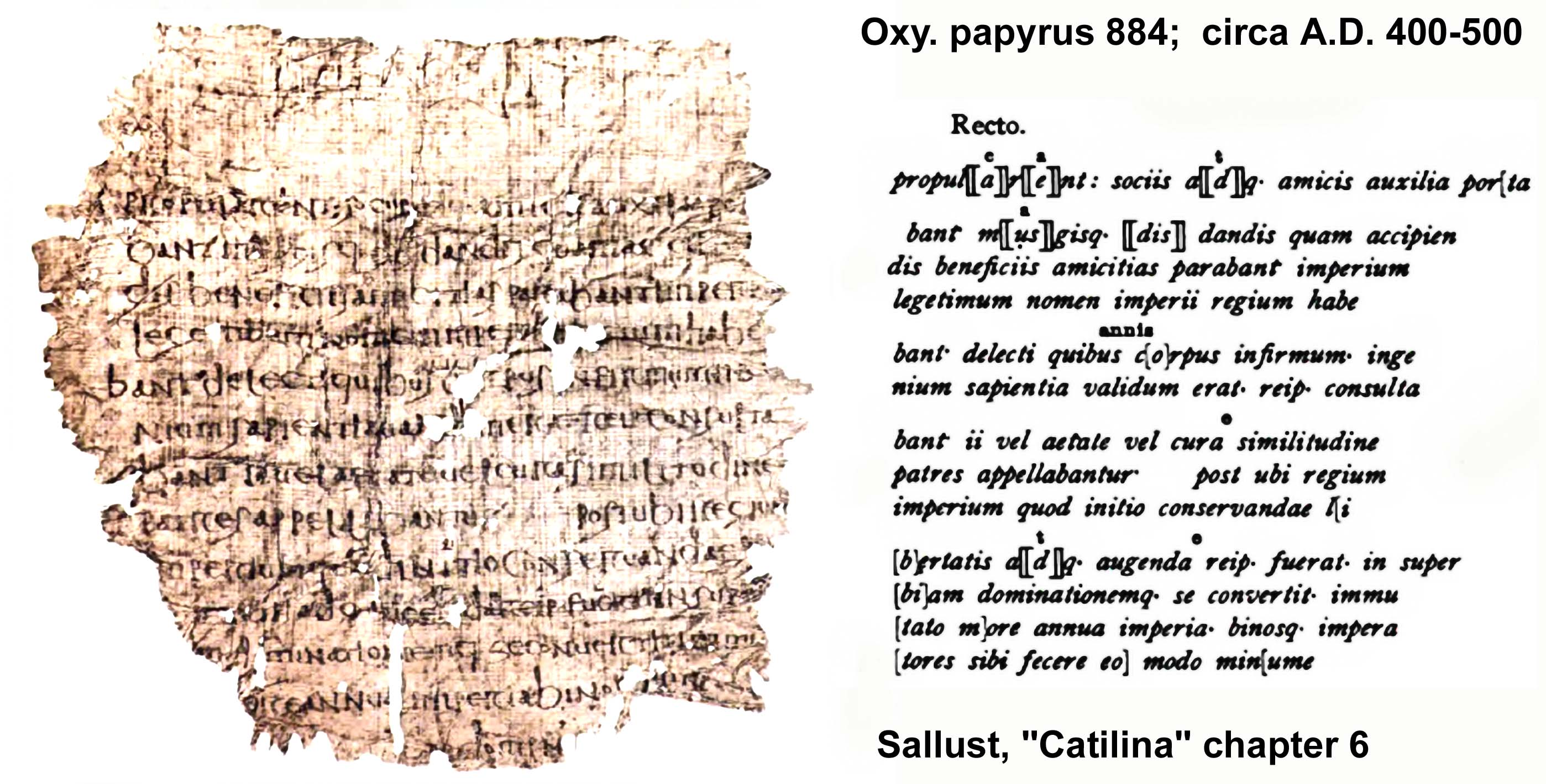
Then there are the texts referred to as "literary," intended for a larger audience: besides the genres we may think of as "literature" in a narrower sense, fiction and poetry and drama, these include works of history and philosophy and science. There's just one copy, from before the age of mechanical and electronic reproduction, of Thaius' letter to Tigrius, presumably either written in Thaius' own hand or dictated to a servant. There may be many copies of a given ancient literary text, but it's rare to find one made within even several centuries of its original composition. For example, as I recently found out, in the case of Sallust' histories of the Cataline conspiracy and the Jugurthine War, written in the 1st century BC, there appear to be over 500 manuscripts in publicly-accessible collections today. But apart from 4 fragments preserved in scraps of papyrus from the 4th and 5th centuries, none of these manuscripts is older than the 9th century. Here's the left edge of one of those papyri:


The fact that several of the manuscripts of Sallust's works are as old as the 9th century is very good. The fact that there are also some older ones known, even if they are just scraps, is exceptional. It's good from a point of view of the manuscripts as objects from the 9th century of historical interest in their own right, and it's also good on the general assumption that the older a manuscript is, the greater the chances are that it preserves the original text, that which Sallust actually wrote, with some sort of accuracy. That's a very general assumption. We don't generally know, for any given manuscripts of an ancient text, how many copies may lie between it and the original. A 4th-century papyrus may be a very sloppy copy of a very sloppy copy of a very sloppy copy... repeat many more times, of the original. On the other hand, a 15th century manuscript may be a very accurate copy of a very much older manuscript which was copied from Sallust's own personal copy. Manuscripts are judged on other criteria than age. But generally speaking, for those interested in accurately reconstructing the original text of an ancient author, when it comes to manuscripts, old is good and very old is very good.

And with very few exceptions, until the last couple of centuries, 9th century was about as old as any surviving manuscripts of pre-Christian Classical authors were. This is one of the main reasons why so many scholars point to the reign of Charlemagne as the end of the Dark Ages: because he instituted an educational program, including the study of those ancient pagans, and many of those 9th-century copies were made because of him. So why don't we have many of the copies from which the 9th-century copies were made? Because, before the Italian Renaissance in the 14th century, it rarely seems to have occurred to anyone in Western Europe that a manuscript -- or a building or anything else -- might be worth preserving simply because it was old. New copies were made, and the old, worn-out ones were thrown out. Some of those pre-9th-century exceptions include 8 4th and 5th century manuscripts of Vergil, and 4 5th century manuscripts of Livy -- at least 4. I know of 4, in addition to some of the papyri described below.

Many more older manuscripts have been found by archaeologists from the 19th century onward, written on papyrus and buried in the desert south and east of the Mediterranean, where, it turns out, papyrus can last for a very, very long time without decomposing. By far the most famous of these finds has been the Dead Sea Scrolls, but that discovery was just one of many. Most of the finds have just been scraps, like the papyrus of Sallust illustrated above, but still, because of their age, they're very exciting to students of ancient literature.

Here's a fragment of the Gospel of John, believed to have been copied out in the first half of the 2nd century, very close to the time that this text was originally written:


Speaking strictly as a layman, let that be perfectly clear, the general impression I get from the comparisons of these discoveries of old papyri with medieval manuscripts and with modern editions of ancient texts is that the medieval scribes tended to be very scrupulous and accurate and that the modern editors tend to be very good at their jobs. I know I could never do what they have done, and I'm very grateful for their efforts.

Sunday, June 21, 2009

Philosopher-Kings

Alexander the Great, the Emperor Augustus,Charlemagne and Napoleon, besides being great rulers and conquerors, had also each of them a great impact upon the culture of his time. Hard-bitten, practical men, politicians and merchants and so forth, often deride culture -- literature, philosophy, art and so forth -- as being both a waste of time and a refuge for weaklings who cannot deal with real life. These practical types tend to measure one's success in "real" life by one criterium: the amount of one's material possessions. At an opposite extreme, one thinks for instance of Nietzscheand Oscar Wilde,are those who maintain that art alone makes life worthwhile. As with many other instances of extreme differences of opinion, so here I feel that such extremes are rather silly. Art is important, but without food, shelter and other basics which the practical types are constantly, industriously providing, no-one would be able to create it. Both extremes contain kernels of truth: often artists are, in fact, pampered sillies who cannot cope very well with the world at large. And art does certainly make life nicer. The practical types probably have no conception of a world completely without art, and would be just as horrified as anyone else if they ever did get a glimpse of such a world.

Whether or not Alexander's relationship with Aristotlewas more than just an interesting historical coincidence, whether Aristotle ever thought of his pupil or Alexander of himself as a philosopher-king, or not -- he died rather young for a philosopher, and in the dozen years of his reign he was extremely busy with practical and political things -- at the very least, one must regard Alexander as an extraordinary patron of culture. Although his empire collapsed into many separate kingdoms almost immediately after his death, still, everywhere he had been, from the Adriatic to Afghanistan, Greek culture flourished for centuries, because Alexander had consciously planted it there. A philosopher, a rhetorician, a musician could travel all over the vast Hellenistic world and find a market for his services in every city, and that he owed directly to Alexander.

It is a commonplace that in the age of patronage, poets and princes had a relationship that was often self-serving on both sides: the princes wanted praise and so supported those poets who flattered them, and the poets realized that the princes were the best patrons, and so flattered ceaselessly, shamelessly and with no regard for the truth. Like many commonplaces, this one overstates the matter somewhat. Doubtless, many writers throughout the ages of patronage were toadies, just as many are today, and many princes were conceited fools ready to swallow any amount of flattery -- as are many leaders and wealthy people today. But it's a great oversimplification to dismiss every description of every prince by the writers of his court on these grounds.

It may not be such an oversimplification, however, in the case of Augustus. Augustus is justly celebrated as the initiator of the pax romana, the greatest period of peace the Mediterranean world, or indeed perhaps any portion of the world at all, has ever enjoyed. Because of his reforms, his institutions and his example, the peace lasted for centuries after Augustus' death. That is certainly to be praised. When one considers the arts, however, a chillier picture emerges. There seems to have been little room for poetry that did not praise the Emperor and his family, and no room at all for anyone who criticized or made fun of them. The Aeniad is a great poem. Perhaps Vergilcould have done no better if he had not been obligated to praise Augustus in his poem. but who knows how many other poets or would-be poets there were, of whom we have never heard, or who never began at all to compose and declaim, because their talent for flattery was too slight? And Ovid,the greatest of all Augustan poets, was banished to a fort on the Imperial frontier on the Black Sea coast, a particularly cruel punishment for such a thorough urbanite. We don't know exactly what Ovid did, how he gave offense to the Imperial house. We can be pretty sure, however, that the offense was pretty minor, of the sort that many princes would ignore, even if it hadn't come from the greatest poet of the age. We know that Ovid apologized profusely, begged pathetically and in vain to be forgiven, until he died on that frontier post. It is generally agreed that Latin literature declined precipitously after the Augustan age. Surprisingly seldom, in my opinion, does anyone think to blame this directly on Augustus.

Alexander and Augustus lived in a culture -- it was in very many respects one and the same culture -- in which it was taken for granted that a sovereign could read and write. By the time of Charlemagne, the Roman senatorial families, the heirs of the rulers of the western Empire, had faded from the scene, any power they might still have confined mostly to the Catholic Church. Almost all of whatever literacy remained was to be found in the monasteries. The rulers of Western Europe, the heirs of the barbarians who had swept away the remnants of the western Empire, could neither read nor write. They fought ceaselessly among themselves, not the least among their own families. Patricide, matricide, fratricide, filiocide and every other sort of depravity was rife, along with famine and plague. To appreciate how great Charlemagne's achievement was, one has to understand how thoroughly awful things had become before him.

Charlemagne united and for the most part pacified a large portion of Western Europe. It's true, he waged war ceaselessly, but he waged it mostly at the expanding borders of his empire, thus pacifying an ever-growing area within. Within his borders, palaces and monasteries were built on a vast scale, and in these monasteries Charlemagne gave great support to learning -- not only Christian learning, but also the preservation of the ancients. In his main palace at Aachen, centuries before universities began to appear in western Europe, there was a sort of academy, from which officials and clerks went to every corner of the Empire. Einhard,Charlemagne's friend, minister and biographer, says that the Emperor himself spoke excellent and fluent Latin in addition to his native German, and could understand Greek as well. The whole time since the collapse of the western part of the Roman Empire, its legitimate heirs had continued to rule in Constantinople. After Charlemagne was named Emperor of the West by the Pope in AD 800, he was, in his own eyes if not in theirs, the colleague and equal of the Byzantine Emperors. In any case, it was only natural that a dominion as large as Charles' would send and receive embassies to and from Constantinople. Einhard also says that Charlemagne tried very hard to learn to write, and was hampered in this only by the fact that he had begun late in life. Charlemagne's vast contributions to letters are not in doubt. Among other things, the first example of written German come from his time, upon his orders. Perhaps Einhard was flattering Charlemagne's memory in his description of the prince's linguistic abilities. We don't know. To me the description has the ring of truth.

A thousand years after Charlemagne, it was once again taken for granted in Europe that princes could read and write. Many other men, however, the bourgeoise, the businessmen, could also read and write, could build palaces, buy fine paintings, produce plays, maintain orchestras and so forth. Their wives and daughters, presumably, often had their hand in all this artistic enterprise. It was not seemly for middle-class women to be obviously, publicly concerned with business, but still they had their salons which could be as grand as those of any princess. For all that titles were losing their significance, however, it was not taken for granted that a man could rise to the rank of king or emperor on his own initiative. But then Napoleon went ahead and did it anyway, and we are still sorting out the consequences of his reign. And the contradictions, which are glaring: this Emperor came to power under the auspices of a Revolution which, or at least so many of its adherents had thought, was to do away with sovereigns. With all sovereigns, once and for all. Beethovennamed his third symphony after Napoleon, then, when he learned that Napoleon had crowned himself Emperor, almost destroyed the score in his rage. He neded up renaming the symphony "to the memory of an heroic man," to the memory of the younger, not-yet-corrupted Napoleon.

Goethewas less disturbed by titles, and met twice with the self-crowned Emperor. Beethoven accused Goethe of being too subservient to Napoleon, but I don't know if the accusation makes much sense. Their lives were so very different that it may have impeded their communication: Beethoven was the son of a musician in an age when musicians were servants. That Beethoven himself refused to be treated as a servant, to grovel before anyone, was a radical break with the past, and was very brave. Far from living out any such traumatic class struggles himself, Goethe was an aristocrat, although not quite as much of one as he claimed to be when describing the past of the Goethe family in Frankfurt, which he consistently, extravagantly exaggerated. He always had servants, he never was one, apart from the formulas of address required among various ranks of the aristocracy, which could very often include such formulations as "I am your most humble servant" and such. Perhaps Beethoven confused such figures of speech with actual servitude. There is no reason to confuse the two things. And in any case writers began earlier than musicians to free themselves from feudal patronage: pen and paper were cheaper than a musical instrument, much cheaper than an orchestra; the princes, although although they usually sought to control literature through censorship, did not compete with the businessmen, the bourgeoise, when it came to printing; and literature may always have attracted more solitary people, more prone to individual assertion and rebellion, than music, which flourishes in the direct interaction of groups.

Goethe himself was a very powerful man, a minister in the state of Weimar who looked after all sorts of things which were by no means confined to the realm of culture -- for example, mining and irrigation were under his purview -- and the most highly-respected poet in Germany, perhaps in all of Europe. The age of patronage had faded to a large degree, replaced by printing presses and mass readerships, and theatres and art galleries open to the public. Then again, things which are often thought of as belonging strictly to the past, have not, upon closer inspection, completely ceased to be. One visited Weimar and hoped to be received by the great man, very much as if he himself were a prince, and not strictly out of admiration for Goethe's talent, although that was always the stated purpose, but in hopes of furthering one's career, either with a job in Weimar or with a recommendation elsewhere. Among Goethe's local circle of friends was a rich and charming widow named Adele Schopenhauer, whose exceptionally gloomy son Arthurwould go on to be a philosopher, one whose fame, in keeping with his dark mood, was destined to be mostly posthumous. Arthur mostly quarreled with his mother, but got along quite well with the Herrn Geheimrat Goethe. Goethe and the young Schopenhauer collaborated on the study of optics, until such time as it dawned on Schopenhauer that Goethe's ideas on optics were unsound. His integrity would not allow him to lie to his master; but the respect he felt would not allow him to contradict him openly. So instead, Schopenhauer moved to Berlin, published his studies on optics, and left Goethe behind.

A few years later a young and still relatively unknown Jewish dandy named Heinrich Heinecame to Weimar and called upon the great man Goethe. Perhaps Heine had been insulted by an antisemitic remark in Goethe's house, or on the way there; for whatever reason, Heine did not deliver the awed respect usual among Goethe's literary visitors; indeed, he seems to have been relatively monosyllabic and just this side of ostentatiously rude. The old Geheimrat tried to draw him out, asked him: What are you working on now? Heine: A version of Faust. Goethe: Do you plan to stay long in Weimar? Heine: Actually, now that I've met your Excellency, my chores in Weimar are completed. And with that the young smart-ass bowed and took his leave. And it turned out that Heine's career blossomed greatly without the protection of Goethe or any other great man, an example of how things were changing. Unfortunately, other things were staying the same: Heine's big mouth, his fearless pen and, to be sure, his Jewish heritage combined to make him intolerable to the powers which were gradually making one Germany out of hundreds of principalities. Like his friend Karl Marx,Heine had to spend most of his life in exile. He settled in Paris and wrote most of his brilliant poems and essays there.

Antisemitism was widespread in Germany, but by no means universal or unchallenged. I doubt that Goethe personally offended Heine, but it's easy to imagine that Goethe's butler or some other of his servants, or one of his aristocratic friends, might have made some crude remark about how things were going to Hell, if this sort of person, pointing to Heine, could now get in to see that sort of person, pointing in the direction of Goethe's drawing-room. One acquaintance, erstwhile friend and colleague of Goethe's who was, unfortunately, clearly antisemitic, was Arthur Schopenhauer. Schopenhauer set himself up at the University of Berlin and quite brazenly announced philosophical lectures to be held at the same time as those of Hegel.Did his failure actually surprise Schopenhauer? Competing as an unknown against one of the most popular philosophers of all time, a thinker who was enjoying rock-star fame, speaking in the largest lecture-halls whose seats were always all taken while many other people crowded into the aisles and entrances, seems like the act of a man who wants to fail, all the better to be able to call all of academia sour grapes.

Whatever his subconscious motivations may have been, Schopenhauer quickly canceled his lectures and settled into a solitary bachelor's life, living comfortably on the income from inherited investments, writing philosophy, not voluminously but very brilliantly, and very biliously. His criticisms of academia in general, and of Hegel in particular, are extreme. Extreme as they are, I admire them, although I wonder if they and I are wrong. To put my cards on the table: I, like Schopenhauer, failed pretty badly in academia and tend to resent it for personal reasons. And I have never begun to understand what Hegel was talking about, and so am perhaps too eager to accept Schopenahuer's analysis: that Hegel wrote nothing but nonsense, that he was an unparalleled charlatan who drastically set back the cause of philosophy. What if Schopenhauer never understood what Hegel was talking about? I'm reminded of the stupid comments against all modern, non-representational or conceptual art, uttered by people who obviously have no conception of any aesthetic ideas from later than 1850 or so, and who probably are just as clueless about earlier art as well. I am troubled by the very many later philosophers who seem to take Hegel very seriously indeed.

In any case, though I tend to nod and agree as I read Schopenhauer's critiques of academia, of Professorenphilosophie fuer Philosophieprofessoren, and of Hegel, I shake my head in dismay when Schopenhauer comments upon the Jews. Still, Schopenhauer had high, rare praise for Heine, whom he discovered late in both their lives. Is it possible that he did not know that Heine was a Jew? (I think he did know.) Or is it possible that Heine's writing caused Schopenahuer to reconsider some of his prejudices? (I think it's quite possible.)

The age of patronage, as it was with Alexander, and still with Charlemagne, and to a large degree still with Napoleon, is now gone -- but completely? I don't know. In earlier ages culture was dependent upon princes. When the prince was enthusiastic and openminded like Alexander or Charlemagne, culture flourished, and therefore life flourished. (I'm closer to the one extreme I criticized at the start of this essay, which states baldly that art alone makes life worthwhile, than I am to its opposite. Maybe I'm wrong when it comes to most people, but in my own particular case I'm right: if I can't be surrounded by, drenched in art, then I'm in a pretty sorry state. I can understand Nietzsche and Wilde pretty well, I can't muster much besides horror when considering a Rockefeller or a Gates.) There are fewer princes around nowadays, the ones who survive have far less power and less to say, in the field of culture as elsewhere; but there still is a type of patronage. Businessmen have to some degree taken the place of princes, and unfortunately they often tend to be somewhere between unsophisticated about and downright hostile to culture. There is large-scale state sponsorship of the arts in many European countries, so large-scale that if they had an inkling of it, many American artists would emigrate. Back here in the home of the brave the most important patrons are the successful artists -- and the philosophers and historians and so forth who have the qualities of artists. Unfortunately we don't have one word which embraces them all, although they are a unity as they always have been, as much now as when Leonardo da Vinci was painting and sculpting and designing buildings and bridges and artillery and dissecting bodies and otherwise embodying the definition of the Renaissance Man -- who recognize and promote and more and more often finance their as-yet unrecognized peers. Ever since Plato, the idea has been to inspire and educate the princes. Well, the princes of the ancien regime are just about gone, and their remnants are more sad than inspiring, let alone inspired, less and less capable of sustaining the old fantasies of good princes. The more successful among the artists, however, have begun over the course of the last few centuries to resemble princes. I'm thinking here more of Coppola than Schwarzenegger, more of Bellow than of Rowling. Clearly, Schwarzenegger has at the moment more political power than Coppola. But one certainly has to hope that Coppola has more power in determining what films will be made, and how and by whom. And that Bellow's appreciative remarks on this or that fellow-writer will still resound when no one any longer remembers Harry Potter.

Wednesday, May 27, 2009

Am I an Historian?

[PS, 19. March 2016: No, I'm not an historian, I'm an essayist with a strong interest in history who's also written novels, stories and plays.]

Well... yes, I think perhaps I am, I think an historian may be what I am turning into. If an historian is someone who not only studies historical topics a lot, but also often has questions, the answers to which he does not find in other peoples' historical writings, and is seized by the strong desire to search among primary documents and artifacts as well as in secondary sources until he finds those answers, and then writes about what he has found, then, yes, I am very much an historian.

Here's an example of one of those questions which occurred to me recently: I had been aware that Johannes Gutenberg, whether or not he actually invented printing, had begun printing sometime in the 1430's or '40's, and from that I had assumed that the editio princeps of many a work of Classical antiquity dated from before 1450. But this appears not to be the case: I know of only one Classical work printed before 1469: Cicero's De Officiis,printed in 1465. Then beginning in 1469 a great number of first editions of Classical authors followed in close succession, with editions of Apulius, Livy, Lucan, Vergil, Caesar and Pliny the Elder all appearing in that year alone,

Why did it take so long for printers to get around to printing Classical texts? Was the interest in Classical material really so small? Were students of Classical literature somehow averse to the new technology?

No, and no. Rather, it seems that I had been puzzled because I made a couple of anachronistic assumptions: that the invention of printing, once achieved, became widely-known with a speed analogous to the news of inventions in out time; and that Gutenberg and other printers would seek out any and all customers for their invention. Actually, Gutenberg, and other of the earliest European printers in Gutenberg's corner of Germany, did not seek to publicize his invention. On the contrary, he tried very hard to keep it secret, so that others couldn't imitate what he did and compete with him. This naturally meant, for as long as they successfully maintained this secrecy, that their potential market remained small and local. And the customers they knew wanted primarily Christian things: parts of the Bible, eventually whole Bibles,and contemporary and medieval theology. The Classical printings came in great quantity as soon as the techniques of printing became less secret, and spread across Europe. This appears not to have happened until about 1469, when it spread very rapidly indeed all over Western Europe.

If I had a little more professionalism as an historian, I could, and would, tell you from exactly whom I learned all this. Unfortunately, I remembered roughly what was said and forgot who said it -- somewhere on the Internet. That was several months ago, though, and I'm getting more conscientious, more into the habit of recording attribution more as a matter of course when I note things. Good historians are good about giving attribution in their footnotes. Not only is this polite and proper, it also answers the question Oh yeah? Who sez? with which we (they? we) are perpetually confronted.

Years ago -- 10 years? 15? 20? I don't know how many years ago, I hadn't gotten into the habit yet of writing such things down -- a question which I much wanted to answer was, What was Charlemagne's native language? I read accounts of Charlemagne in several history books without learning the answer, until I found it here: Karl der Große. Mit Selbstzeugnissen und Bilddokumenten,by Wolfgang Braunfels. It turns out that Charlemagne's native langugae was German; in fact, the written German language pretty much begins in his reign, and, more than that, at the very least the process of making German a written language received his strong support. It may have been his idea. (In those days people tended to write in languages which already had a tradition of writing: Latin, Greek, Hebrew and so forth -- mostly Latin in Charlemagne's Empire -- and it seems only rarely to have occurred to anyone to write in one of the various spoken languages of Europe.)