Showing posts with label socialism. Show all posts

Tuesday, December 7, 2021

Dream Log: Left-Wing Think Tank

Recently I had another one of those dreams about an abnormally-huge building. 

I dreamed I was walking by the side of a road in the Detroit area. There were no distinguishing Detroit landmarks, but I knew where I was. Snow was piled up high everywhere except for the road, and I often had to wade through it in order to stay out of the way of traffic. There were no sidewalks. I had no vehicle, no money and no place to go.

The first building I looked at more more closely was very large, but not abnormally so. I went in through a loading bay and saw that it was a warehouse holding second-hand clothes. The used clothes made a surprising contrast with the new, generic-industrial-park exterior of the building. 

Walking further along the road, I passed two buildings which had been abandoned and were beginning to crumble. The first had once been a large bank in the middle of its parking lot, with several lanes for drive-through traffic.

The next building harder to identify. It was several stories high, it high white aluminum siding which was discolored in patches. 

And then I came to the abnormally-large building. There were cars in its parking lot, new ones. I walked through an entrance with two sets of automatically-sliding glass doors. The place looked like a hospital, except that I couldn't see any signs pointing to this department and that. A lot of people were bustling about, but the rooms were so huge that the place was not at all crowded. 

I walked through one high-ceiling after another, continuing to see many people and no signs. I also didn't notice any ID cars/security keys.

Most of the rooms were very monochrome: all the walls of each room were the same color, with large, expensive-looking sculptures always exactly matching the color of the walls. I was reminded of those men's suits with jacket, shirt, tie and trousers all exactly the same color. My initial impression was that I found the decor unimpressive. My second thought was that the amount of work which had gone into this whole huge interior, the amount of thought and planning, was impressive. The ambition was impressive whatever one thought of the finished product.

Eventually my presence was noticed. Instead of being briskly shown back outside into the deep snow, as I expected, everyone was very friendly and very nice. People asked about my circumstances, and I honestly replied that I was homeless and broke. People asked whether I was hungry and tired, I said yes to both questions. After being handed a faux-leather pouch stuff very full of 20-, 50- and 100-dollar bills, and then given a nice faux-leather backpack to carry the pouch, just because it was too big to fit into any of my pockets, I was given a very nice meal, and then shown a very nice room, and told it was mine. It contained a big bed, a big desk, its own big bathroom with a really huge shower, and just lots and lots of room and nice furnishing.

The next day, I was told that the director wanted to speak with me. I told myself that this might be where I found the big catch to all of this nice stuff. Like maybe that this was a cult, and I'd never leave the place alive.

The director's appearance did not immediately allay the cult suspicions: Like the ground-floor rooms, his attire was monochrome, but more like that of the villain in a 1950's sci-fi movie than a more recent fashionable man's suit. The director was tall and wiry, with blonde hair and blue eyes.

"What have you been thinking about?" he asked me.

"Andre Gorz," I replied, "and the necessity of changing from economic to ecological thinking."

"You agree with Gorz about that?"

"Absolutely," I said.

"I agree too," the director said. "But there are a lot of difficult details to be worked out."

I finally just asked straight-out what had been puzzling me the whole time: "What is this place?"

"A left-wing think tank."

Wednesday, November 7, 2018

MB&F L’Epée 1839 Grant

This is Grant.


Grant can be moved into 3 different positions, and is about 7 inches wide and 8 inches long.


And, as you can see by this photo --


-- Grant is a clock, a joint venture between the companies MB&F, who make mostly somewhat out-there watches, and L’Epée 1839, who make mostly weird and playful clocks. Grant is named after a WWII tank which was named after Ulysses S Grant, was made in a limited edition of 150 pieces, and retails for a little over $20,000, which is a real bargain when you look at all of the high-quality craftsmanship and fine materials which have gone into this piece.

Can we talk about socialism? There are some socialists who hate wealth and money and want to do away with it. Then there are socialists such as myself and George Bernard Shaw. Shaw wrote, in the Preface to Major Barbara,

"To teach children that it is sinful to desire money, is to strain towards the extreme possible limit of impudence in lying, and corruption in hypocrisy. The universal regard for money is the one hopeful fact in our civilization, the one sound spot in our social conscience. Money is the most important thing in the world. It represents health, strength, honor, generosity and beauty as conspicuously and undeniably as the want of it represents illness, weakness, disgrace, meanness and ugliness. Not the least of its virtues is that it destroys base people as certainly as it fortifies and dignifies noble people. It is only when it is cheapened to worthlessness for some, and made impossibly dear to others, that it becomes a curse. In short, it is a curse only in such foolish social conditions that life itself is a curse. For the two things are inseparable: money is the counter that enables life to be distributed socially: it is life as truly as sovereigns and bank notes are money. The first duty of every citizen is to insist on having money on reasonable terms; and this demand is not complied with by giving four men three shillings each for ten or twelve hours’ drudgery and one man a thousand pounds for nothing. The crying need of the nation is not for better morals, cheaper bread, temperance, liberty, culture, redemption of fallen sisters and erring brothers, nor the grace, love and fellowship of the Trinity, but simply for enough money."

(My emphasis, lest some careless reader think that I or Shaw were telling the lazy poor to complain less and work harder.)

The other sort of socialist -- the Puritan sort, even though they often are atheists -- will point to things like Grant and say that they represent all that is wrong with the world. They may bite their tongues, if they were raised as Christians, to keep from saying "all that is wicked," but that's what they mean. Shaw and I favor universal basic incomes, that is: giving money to everyone, because everyone should have it. We see nothing wicked about Grant. What is wicked to us is that the world is arranged so that so very few people can afford to buy themselves something like a Grant, if they so choose. (Not everyone could buy a Grant even if everyone were rich, because there are only 150 of him, but there are many extravagant things like Grant.) And that other sort of socialist, the Puritan kind, ought to brush up on their Marx, especially Marx on the subject of leisure, if they think Marx is on their side, and not not mine and Shaw's.

It strikes me how many of these socialists who say they're against wealth are a lot wealthier than I've ever been. They have varying definitions about how wealthy is too wealthy, but, conveniently, it tends to be much wealthier than they are. Bernie Sanders may well be a millionaire, but billionaires really grind his gears. For them not to be much more focused on poverty requires, I think, both a lack of experience of it, and a lack of empathy. It happens now and then that a rich Puritan socialist will actually give away everything they have, to the point where they actually become poor on purpose, but it doesn't happen often. Shaw, as far as I know, was never close to being poor, but he was gifted with enormous empathy. He was able to spot suffering without having experienced something similar to it himself. And he was clever enough to see that one doesn't reduce the amount of misery in the world by becoming miserable.

Anyway, I just came here to say: lookit Grant, he's wicked cool!

Friday, September 7, 2018

Socialism in the US

Some of the Democratic candidates in the 2018 mid-terms, most prominently Alexandria Ocasio-Cortez, are referring to themselves as socialists, which is freaking some people out.

Although this is a huge problem, it's a purely semantic problem.

Part of the problem is that anti-socialist propaganda has been extremely successful in the US, and Americans have been very effectively cut off from news of socialism in the rest of the world, so that people in the US often lose their minds as soon as they hear the word "socialism." Socialism has functioned perfectly well in the UK (where it's called the Labour Party), France , (West, and then reunified) Germany, Italy and the rest of Western Europe, but in the US, it faces unique obstacles. For example, all of the Americans who "hate Marx" without ever having read anything written by Marx. Many Americans "hate socialism" without knowing what it is. It's basically what the Democratic Party stands for: good wages, health care, a clean environment, good and affordable (or free) education, etc. It's help for people who actually need help, instead of for the rich people who already own most of the US and are outraged that they're not allowed to pollute more and pay their workers less.

Part of the problem is that for the moment, in the US, the term "socialist" has been partially monopolized by Bernie Sanders, who is no more socialist than the left wing of the Democratic Party, and whom people dislike for all sorts of perfectly sensible reasons which have nothing to do with socialism. Basically, Bernie is the worst thing to happen to the Democratic Party since Ralph Nader. Bernie, a socialist? It's a joke! He's too anti-social to have belonged to a political party for most of his career, until he joined the Democratic Party in time to ruin things for Hillary, to help Trump get elected, and, above all, to feed his seemingly insatiable ego. He moved from multi-cultural Brooklyn to lily-white, affluent Vermont, where they use a lot of green power, which is good, but don't participate very much in the actual socialist (that is, working-class) struggles going on the US.

Socialism is as American as FDR and LBJ -- even though both of them, unfortunately, avoided the label and left it to be used as a weapon against them by their libertarian rivals. It's as American as FDR's cousin Theodore breaking up the biggest companies in the US in order to stop them from taking over the US. Hopefully, soon, Americans will finally learn what the word means, and realize it's something they know and have been voting for all along.

Saturday, September 2, 2017

Trump, and Capitalism's Reputation in the US

It appears that John Kelly may have had enough of Donald Trump already, after just 5 weeks as his Chief of Staff. Anonymous sources say that after a recent Trump meltdown directed at Kelly, Kelly told other White House staffers that he had never been spoken to that way in 35 years of service to the US, and that he didn't intend to put up with more of the same. So, that might mean that Kelly is about to resign, or that he's about to look Trump in the eye and tell him to shut his pie-hole. Which might get him fired.

Well, that's our Donald, isn't it? Just making friends wherever he goes. A lot of people are paying close attention to Trump's behavior as President, and asking themselves how in the world he managed to have a career as a businessman for so long before becoming President. I think that the answer may be that his career up until January of this year was as a pure capitalist.

Now, many people are capitalists, but few are pure capitalists, in the sense that making money is honestly the only thing they care about. Most of us care a lot about money, because we live in a capitalist system, which means that only those with a lot of money can afford to pay little attention to it -- and even those, if they pay little enough attention to it, may run out of it, meaning that they will be forced to pay as much attention to it as us poor schlubs.

The thing is, though, very few of us care only about money. We may care quite a lot about our friendships and relationships, or music, or animals, or painting, or food or wine or mechanical watches or sunsets or trees, or some combination of those things and/or many others, without consideration of financial ramifications. An expert on pino grigio or Mexican food may make a living through that expertise, but there's very little chance that they study the wine or the food only for the money. In fact, it's just about guaranteed that they love the food or the wine passionately and would spend a lot of time on it even if they lost money on it rather than making money. Many people, probably most people, aren't lucky enough to be able to make a living at something they love, but they still spend a lot of time and energy on things that don't earn them money. Friends and family are a very common example, and then there all the other things I just listed off, and many more. It's very rare to come across someone who really only cares about making money.

And yet, the only thing rewarded by capitalism is a focus on money and money alone. Capitalism is only concerned with quantity. Quality -- of life, or of anything else -- is not capitalism's concern. We think of our society as a capitalist society, and yet almost all of us spend a lot of time behaving in ways which are contrary to the principles of capitalism -- excuse me, I should say say: contrary to the principle of capitalism, because there's only one: get yours, and then got more, and then repeat, and never stop.

Anybody who has thought about this a lot, and realized that capitalism by itself comes very short of fulfilling all of our wishes and ambitions, is already to some degree a socialist, whether he or she suffers from the typical American ignorance of what socialism is and horror of the term "socialism," or not. I was thinking here about pino grigio and Mexican food because, on the Food Network and the Cooking Channel, I've been struck by one particular sort of bio among highly-regarded chefs: they used to work in finance, and they gave that up to make the plunge into trying to cook for a living. Those people are a clear example of rejecting capitalism for socialism, at least partially. If they were really all about money, they'd just go back to their former jobs, done. They've realized -- even if they haven't realized it consciously, because they're constantly bombarded by American pro-capitalist myths in advertising and many other places -- that there's much more to life than how big your stack is.

And then there are horrible assholes like Donald Trump, and the AIDS medication douchebag, who really, truly care about very little except getting theirs, and then getting more, and repeat. This makes them horrible people, and, at the same time, very efficient capitalists, just by virtue of being distracted by so very little else except getting theirs, and then getting some more, and then repeat. The AIDS medication douchebag is so repulsively smug, even as he has been convicted of fraud and awaits sentencing, because he knows that all he has done is what our society says you should do: get yours, etc. He doesn't realize to what extent our society -- in most cases subconsciously -- rejects capitalism, because we -- usually subconsciously -- realize that pure capitalism results in people like our current President and the AIDS medication douchebag. People whom we reject with horror.

And so, I would suggest that those who are flabbergasted by the fact that Trump was able to survive for so long as a businessman, before beginning his spectacular failure as a politician, think more about money and capitalism, think more about what they are, and how horribly overrated they are in the US, how we give capitalism and horrible capitalist douchebags far too much power.

At least read some Marx before continuing to react with horror to what you think Marxism and socialism is. At least get some clue about what it is you're reacting against. For about half of the 68 years of the Federal Republic of Germany so far, the Chancellor, the Bundeskanzler, the closest equivalent they have to the US President, has been a member of the Social Democratic Party, the SPD. The SPD is the oldest currently-active political party in Germany, going back under different names to the 1860's. Karl Marx was a member. The SPD isn't very different from the Democratic Party in the US. They're somewhat more conscious of the nature of capitalism.

Perhaps the horrible catastrophe of the Trump administration will cause Americans in general to become more conscious of such things, and more critical of capitalism on a conscious level.

Friday, March 3, 2017

"As Featured In"

I still don't know exactly what "as featured in" means, but I'm pretty sure there are few phrases which mean less.

About 144,000,000 results (1.19 seconds)
No results found for "what does as featured in mean".
Results for what does as featured in mean (without quotes):


The first few results which were found don't help much.

What I'm talking about is ads like this:

Experience our shamelessly-overpriced-at-$100, brass-plated, inaccurate and undependable quartz-powered disposable watch, as featured in House & Garden.

Ads plugging some obviously cheap and fake imitation of something better, "as featured in" some publication aimed at a market much too upscale for it.

2 possibilities occur to me about what "as featured in" might mean: 1) The watch was advertised in House & Garden, quite possibly with an equally-empty boast about how it had been "featured in" some other upscale rag; or 2) It's quite simply a shameless lie: there has never been any connection between this cheap brass-plated piece of failure and House & Garden, and the people who made the watch are betting that the people at House & Garden will either never hear about the lie, or not care.

(Btw, I'm sorry to have learned that House & Garden has not been published in the US since 2007.)

Enthusiastic supporters of capitalism are eager to talk about things such as IBM, Warren Buffet and General Motors, and less eager to talk about Donald Trump, the AIDS medication douchebag, homelessness, junk mail, and junk products "as featured in" this or that place. Let alone the relationships between the former and the latter. Gung-ho capitalists talk about how capitalism rewards hard work, integrity, dependability and other fine things, and in some cases, it has; but in many other cases it has rewarded entirely different things, such as naked greed, ruthlessness, indifference to people's or animals' health and well-being, deviousness, and having been born rich.

Some people say that capitalism has triumphed, others, that capitalism has failed. Some say that socialism has failed; others, that its triumph is inevitable. There is very, very little which I regard as inevitable. Also, where many or most others see black and white, I see grey, perhaps because I am less focused on how I believe things should be and more focused on finding out, as well as I can, how things actually are. I think that what we have now in the large state-run economies of the world, and have had since well before Adam Smith, is a mixture of capitalism and socialism. I think that less capitalism and more socialism would be a fine thing. But I don't think that more socialism can be imposed upon people against their will. I believe that, unfortunately, there is a widespread tendency to unquestioningly accept capitalist propaganda -- to the point that people will giggle when I say something which isn't funny like "capitalist propaganda." The fact that they giggle is one example of how successful capitalist propaganda has been.

Still, perhaps things like the 2007-2008 worldwide economic disaster and the disaster of the Trump administration are encouraging more people to think more deeply about economics. One issue where my attitude is close to black-and-white is education. I firmly believe it's a good thing. Remember how during the Presidential campaign Trump said he loved the poorly educated. Hopefully it's becoming more clear to more people that that love is not that of a shepherd for his sheep, but that of someone looking to shear the sheep and sell the wool for exorbitant profits, not to mention selling cheap brass-plated piece-of-junk watches to rubes for 20 times more than the most they could possibly be worth.

Friday, September 30, 2016

Overcoming Bad Mental Habits

Western civilization: 2000 years ago, although the mass of people were in some senses less free than they are today -- for example, as many as 15% of the people in the Roman Empire, and as many as 40% of the population of Italy, were slaves -- still, most of them, even the slaves, were somewhat freer than we are today to speculate about religious matters.

That freedom of discussion began to go away as Christianity began to take over in the 4th century, and by the end of the 5th century, like the Roman Empire's territory in the West, it was almost completely gone.

Western civilization had adopted a very bad idea: that there was only one true religion and that no-one was allowed to have any other opinions about it. We in the Western world began to shake off this intolerance of discussion of religious things in the 17th century, and we're still shaking it off.

As Christianity has faded, capitalism has grown. As there was with Christianity before, there is very little tolerance for people (socialists) who say that capitalism is a bad idea. There is constant discussion about what kind of capitalism is best, much as the Western universities were once dominated by discussions of what kind of Christianity was best, but to say that capitalism itself is something which must be overcome is still today a lot like saying several centuries ago that Christianity itself was nonsense: it's bad for a career in business or politics.

Now I want to make it as clear as I can that I did not just say that capitalism is a religion. I said that I saw a similarity in the development of the two and their places in Western society in two different eras. But they're not the same thing.

If I point out that a cat and a dog both have fur, I am not saying that a cat is a dog or that a dog is a cat. That would be ridiculous.

But a lot of Christian theologians have said that capitalism is a religion. Other people have said it too, but it seems to be very common among the theologians to say that this or that thing which is not a religion, is a religion. Karl Barth said that everyone has a religion and that therefore everyone is a theologian of some sort.

Theologians are constantly saying completely nonsensical things like that. It seems to me that they have to say all sorts of nonsensical things in order to sustain religious belief, or, more precisely, in order to impede clear thought about religion.

Capitalism is not a religion. Neither is socialism, or golf. But because we in the Western world have become so inundated with theological nonsense and so used to it, many of us fall for absurd notions such as that a way of doing business or a sport can be a religion.

Clear thinking about religion tells us that, although it may have been very useful in the past, and may still serve many functions today, its major premises about supernatural creators and guardians and eternal reward and punishment and so forth, are all unsound.

Similarly, and once again I am by no means saying that capitalism is a religion, clear thinking about capitalism tells us that it has many shortcomings among its basic premises, and that we can do better. Capitalism is dog-eat-dog. It rewards sociopathological behavior. It is deeply, inherently unfair.

It is not particularly unusual for me to say that I am an atheist. It's becoming more and more common for people to just come right out and say that they're atheists. And we're not all extremely pugnacious and unpleasant about being atheists, the way that the New Atheists are. We're getting closer and closing to the level of religious tolerance which existed in the Roman Empire 2000 years ago, when it was taken for granted that anyone was free to say want they wanted about religion and to believe and practice as they wished, and it was considered quite rude to denigrate anyone else's religion and insist that one's own was the only correct one.

They may be very many people today who believe that it would be best if society were organized so that everyone contributed to the well-being of all according to their abilities, and was cared for by all according to their needs. That's socialism. Capitalism and socialism are incompatible. Almost all of us are part-capitalist and part-socialist: part-capitalist because we have to be in order to survive within the capitalist system which dominates the world today; and part socialist, because we're decent human beings. There are very few people who are purely capitalistic all the time. They are awful, disgusting people like Donald Trump and the AIDS medication douchebag. But they are following the rules of capitalism very strictly: buy lo, sell high, put off payment as long as possible, don't let your effect on others even enter into your thoughts -- and because they've followed these rules so consistently, they're very rich. Very rich, loathesome sociopaths. The AIDS medication douchebag was always smirking in court and during interviews because he knew he was following the rules of capitalism. What's clear neither to him nor to most of the people nauseated by his behavior and smirk is that following the rules of capitalism all the time makes you a disgusting person.

Not all investors are the same, of course. Not all extremely wealthy people are the same. Not all capitalists are capitalists all of the time. Different billionaires get their billions in very different way, and do very, very different things with their billions. If Bernie Sanders grasps that, he's trying very hard to make it seem as if he doesn't. Prejudice is forming opinions about someone based on their membership in a group, rather than regarding them as individuals -- even if that group is the group of billionaires. Some billionaires are socialists to a very great degree, whether Bernie can grasp that or not, and whether the part-socialist billionaires realize it themselves or not.

"Antisocial" means both that you're against socialism and that you're an unpleasant person. "Social" means the same thing in both cases, and also in the case of the term "sociopath." Exactly the same. If you're an investor and you take actions which will tend to extend the life of the petroleum industry and hinder the growth of green energy, because you calculate that it will make you more money, you're a sociopath -- and a perfectly good capitalist. Watch the money shows on TV: the effect which investments will have on others never enters into the conversation unless someone has made a calculation that "green stocks" will make more money than others. On the money show this is all completely out in the open. Nobody's even the slightest bit embarrassed about ruining things for other people. The effect on other people is 100% beside the capitalist point of why they're there.

Capitalism = getting more and more money for yourself. Socialism = making the world a nicer place: cleaner air and water, fewer starving people, etc.

And none of that is exactly rocket science, but very few people are willing to face what they're able to understand about socialism and capitalism, the same way that very few people were able to face the fact that the stories in the New Testament made absolutely no sense, and that is was absurd to base all of society on them, although that, too, was quite plain to see, if one would but look.

Saturday, March 26, 2016

Bernie Supporters: No Offense, But You're A Bunch Of Schmucks

1) so Bernie's a Socialist, huh? What's the name of the Socialist party Bernie belongs to, again? Who are some of his colleagues from that party? Uhhh, uhhhh, uhhhhhh...

You're darn right, uhhhh. Bernie's a Social Democrat, but the part of the history lesson he leaves out is that the rest of Democratic Party are Social Democrats too. The US has this irrational phobia about the word "socialism," but what it is is things like Social Security, Medicare and Medicaid, the Postal Service, publicy-owned utilities, unions, increasing the minimum wage, health care for everybody, etc. Democratic stuff. Look at Bernie's voting record. He's just another liberal Democrat, and he's scammed you all into thinking he's something completely new and special.

2) Hillary's a liberal Democrat. Boy, the far Right has got to be loving the way you schmucks hate her, because they hate her too. They hate and fear her more than anyone else in the world. And the people they hate the most are not the Democrats who are so centrist that they're practically Republicans, it's the liberal Democrats who kick ass. (Known in other countries as Socialists or Social Democrats.) Like Hillary. Above all, Hillary.

You're such schmucks! Educate yourselves!

I know you won't. I tried.

Thursday, July 2, 2015

"Libertarianism, Therefore, Is The Representation Of Property In Government -- "

" -- the right which it demands is the right for money to rule. In this respect libertarianism is the new aristocracy. Its substance is the same as that of the old aristocracy, only its name and slogans have changed. The libertarian money-aristocracy, the worship of mammon, wants to rule in the name of 'freedom' and to repress the powerless, that is: those without property. The old absolutism was at least honest, and ruled in the name of power and said openly: 'l'etat c'est moi!' ['I make the law.'] The libertarian money-aristocracy, on the other hand, formally recognizes the people's rights and says that it wants a government of laws, and that the representation of the people is the ultimate purpose of the state. Nevertheless, it claims to be the law of the people and the people's representative."

("Der Liberalismus ist also die Vertretung des Besitzes in der Herrschaft; das Recht, welches er verlangt, ist die Herrschaft des Geldes. In dieser Beziehung ist der Liberalismus die neue Aristokratie; ihr Inhalt ist derselbe mit der alten Aristokratie, nur ihr Name ist geaendert und ihr Panier. Die liberale Geldaristokratie, der Mammonismus will unter dem Firma der „Freiheit" herrschen und die Machtlosen, d. h. die Besitzlosen unterdruecken; der alte Absolutismus war wenigstens ehrlich, er herrschte auch unter der Devise der Gewalt und sagte offen: l'etat c'est moi! die Volksrechte habe ich. Die liberale Geldaristokratie aber erkennt die Rechte des Volkes, ein Recht des Rechtstaates, an, will nach ihren Worten den wahren Rechtsstaat herstellen, indem sie die Volksvertretung als den ureigentlichen Zweck des Staates hinstellt, sagt aber nichtdestoweinger, dass sie selbst die Volksvertretung, das Recht des Volkes, sei.")

What's that, a manifesto written after the 2007-2008 worldwide financial crisis and the huge bailouts of financial firms? No, it's older than that. 1930's Great Depression socialism? Nope. It was written in 1846 by Ernst Dronke, one of the original Commies, a German who occasionally rubbed shoulders with Karl Marx, and who like Marx spent the last several decades of his life in exile in England. Some of this original Commie stuff really holds up, really stays fresh, unfortunately. Unfortunately, because the goals of people like Dronke and Marx are not much closer to being realized than they were in the 1840's.

Maybe they're at least becoming more comprehensible to more people. In the light of long and ever longer experience of the problems they describe.

Thursday, November 20, 2014

Does Democratic Rule Equal Social Justice?

The question cannot be meaningfully answered as posed in the title of this piece, because "democratic" and "justice" are both subjective terms.

The influence of the laissez-faire economics of Adam Smith is still very strong in the US, with its notion that everything will be wonderful and all will live in abundance if only businesses are left alone to do as they see fit. "Laissez-faire" translates pretty much to "leave it alone," and "it" is business. Smith argues that if businessmen were just left alone to do what they do, an "invisible hand" will guide them to act to the benefit of mankind. Making their businesses more economically successful and creating a more just world with less squalor and poverty will be one and the same.


Amazingly, nearly two and a half centuries after Smith began to spread his ideas of the all-beneficent, all-curing invisible hand, people still behave as if it actually made sense, despite massive evidence to the contrary having accumulated in the meantime. In this as in so many things, it's impossible to know how many people really think it makes sense and how many say they do because they see a chance for personal gain. Ronald Reagan's plan of "trickle-down economics" is very Smithian: cut taxes, and cut social programs paid for by those taxes, and poor people will not suffer, because the resulting growth of the economy will benefit them more than the social programs did. In 1980, running against Reagan for President, George Bush Sr referred to the trickle-down idea as "voodoo economics;" later in 1980 he became Reagan's running mate and got on board with the Gipper's economic plan. People naturally assumed that Bush's criticism of trickle-down economics had been sincere, and that his apparent change of heart was a matter of political calculation, but in politics as in economics, who knows who's being sincere when, and for what what reason? Maybe Bush was in favor on trickle-down all along, and only criticized it in order to attack Reagan and try to win the nomination. Who knows.

For advocates of laissez-faire, trickle-down, liberatarian economics, taxes and government regulations concerning business are tyranny, they are un-democratic. For others -- let's call ourselves what we are: socialists. Let's stop being afraid of that word -- unrestricted businesses can be a prime source of tyranny, driving down wages, forming monopolies, fixing prices, profiteering from pollution and wars and other man-made catastrophes.

I'm a socialist, but I'm not asserting that every corporation is unmitigated evil. Mitt Romney was wrong, of course, when he said that corporations are people, but if what he meant to say was that individual people make up, control and operate businesses, and that these individual people can choose different ways of going about their business, and that therefore every business should be regarded as an individual case, just as every individual human being should be, then of course he was right. Still, by and large, over the course of the 2 and a half centuries since Smith, corporations have provided an immense amount of evidence that they should be watched carefully by governments, and regulated when necessary, because if Smith's invisible hand really does exist, if it's unregulated, much of the time it's giving most of us the finger, not looking out for us.

I say that many of us are socialists and should stop running from the term. That's because minimum wages, universal health insurance, regulations against pollution and against monopolies, universal education, universal nutrition and so forth are all socialistic. Like most of the rest of the countries on Earth since the US was founded, the US follows a combination of laissez-faire and socialistic policies, and there's a constant debate and power struggle between the 2 tendencies, which we also call conservative and liberal. Same thing. As long as you keep in mind that in most countries, "liberal" doesn't mean what it means in the US, it means "libertarian." One of many good reasons to call ourselves what we are, socialists, is to help Americans and non-Americans each understand what the other group is talking about.

To return to the title of this post: does democratic rule equal social justice? We will make more sense in our political debates, we will have a greater chance of getting along with each other, if we realize that we don't all define terms like "democratic" and "justice" in anywhere near the same way. And the example of how businesses are treated is just one way in which those terms are defined differently by different people. They're also applied in very different ways to issues of gender, ethnicity, freedom of speech, education, etc, etc. Some would say that I'm a moral relativist and that I'm attempting to thrown open a door to social, political, economic and other kinds of chaos. I would reply that, yes indeed, I am a moral relativist, and that all I'm trying to do is draw attention to the vast levels of chaos which already exist, chaos to which most people's eyes are stubbornly shut. Which is not surprising, it's a scary sight. Still I draw attention to it in the hope that seeing the chaos somewhat more clearly will be a beginning of a chance of reacting to it somewhat more effectively.

Monday, July 8, 2013

I Was Too Lazy To Remember To Buy Some Of Those Re-Usable Cloth Shopping Bags --

-- until finally someone just gave some to me, and that's what I've been using ever since.

And usually, when I'm going through the self-checkout at a supermarket with those cloth shopping bags, I do something wrong when putting my bags in place in the bagging area, and get the "attendant has been notified to assist you" message. (Only just now, back from the supermarket, having gotten that error message again, did it occur to me to watch other shoppers with reusable bags, see if they've figured it out, and if so to copy them.) A couple of times I didn't get the error message and I thought I'd figured it out, but I'm still not error-free every time. I'm apologetic to the attendants about this, but they don't seem to mind much. One of them even pointed out that if it weren't for customers like me making such mistakes, Kroger's would have less use for employees like him.

We're co-operating, the employees and I, and I'm using the bags to try to help out people in general, help us not poison ourselves so quickly. I have no idea how much difference re-usable shopping bags make. I don't know how much difference they would make if everybody used them all the time. One could examine Europe, where it seems most people having been using re-usable bags most of the time for decades now. To me, this is what socialism is: people trying to co-operate for the common good, thinking that a rising tide floats all boats, whereas capitalism is a fight: you win because somebody else lost, or vice-versa. I was very struck by the stories of bicycle-sharing programs I began to hear about in the 1990's because they operated on the same principal as car-sharing programs I imagined as a teenager in the 1970's, living in a city filled with huge parking lots full of cars going nowhere, and it struck me how much more efficient it would be just to use much fewer cars, but communally, leaving them unlocked with the keys in the ignitions.

But of course bike-sharing programs only work if people co-operate by not stealing the bikes, and car-sharing programs haven't been tried because we just don't trust each other enough yet that the very idea would strike most people as more than a crazy pipedream.

Trust is voluntary. Although I don't believe for a second that the Soviet bloc was as bad as capitalist propaganda sometimes portrays it to have been, it was imposed by force. A system based on the proposition that sharing is better, was imposed by force. A tremendous contradiction. Perhaps socialism can only prevail by persuasion and education, until people willingly adopt it because they see its benefits, and because they see the tremendous amount of waste, suffering, pollution, disease, etc, inherent in capitalism with its misanthropic every-man-for-himself approach.

If you're not yet familiar with bicycle-sharing programs, research them, and then imagine that the same thing were done with automobiles, and that it worked. [PS, 28. April 2015: As some of you probably knew when I first wrote this, and I found out since, people ARE doing it with cars. One company doing it is called Zipcar] So much less blacktop needed for parking lots, so much more green, so much better health for all of us, even not factoring in the benefits of the increased bike-riding and walking and public transportation and so forth which would naturally come with such a big shift in thinking. You may say that I'm a dreamer and so forth and so on, but I'm not the only one, et cetera, and if we don't imagine paradigm-shifting improvements in our behavior, how are they ever to come about? Through capitalism's invisible hand? No, I really don't think so. Capitalism may well have been a tremendous improvement over mercantilism, but that was centuries in the past, and we can do much better, and when we do hopefully we won't repeat the mistake of so many capitalists of thinking that we finally possess the best-possible way of doing things. Hopefully we can be modest enough to see that progress doesn't stop with us, having come at last to its ultimate fruition, and that given more progress, people in the future will come up schemes for getting along with each other far beyond what any of us now can envision.

Imagine no junk mail. I mean none. How big a forest is that?

Wednesday, February 6, 2013

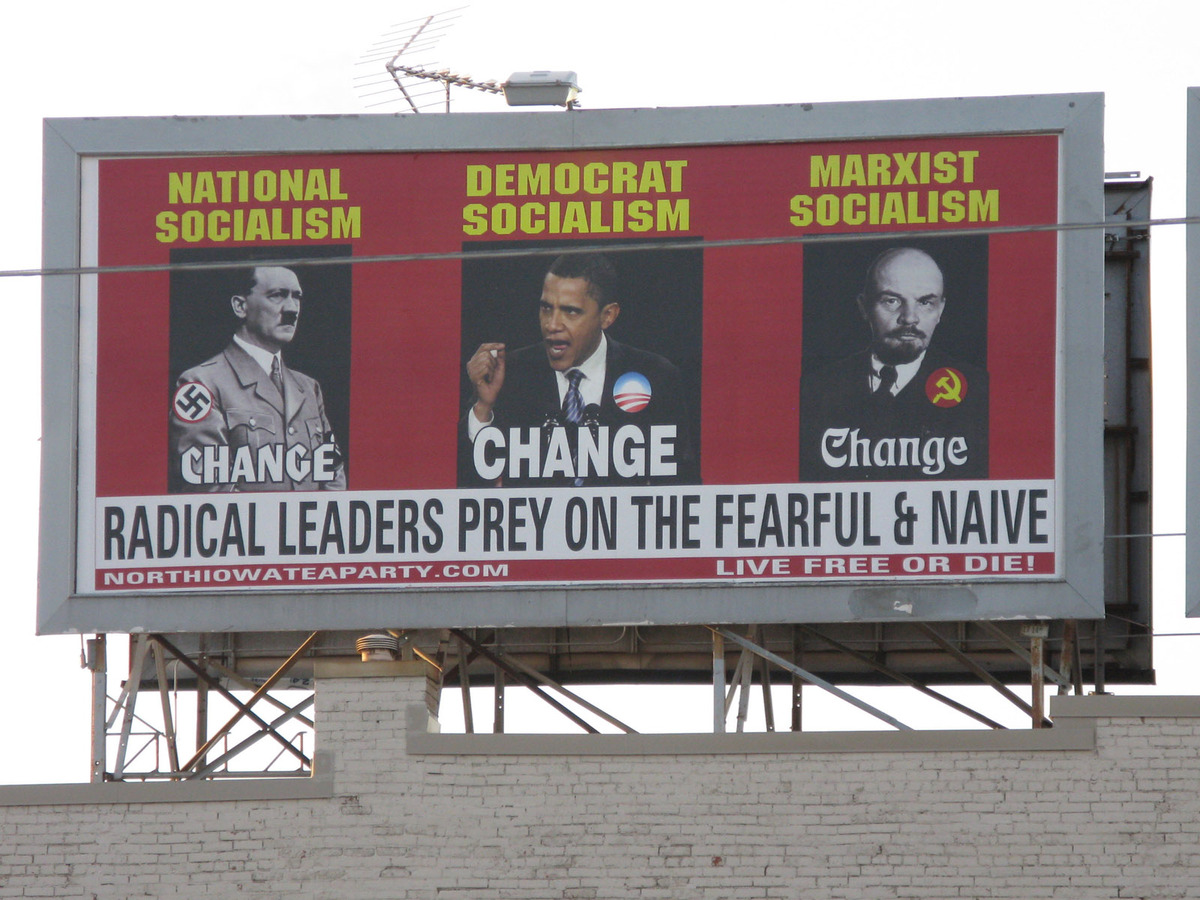
"McBain To Base: Under Attack From Commie Nazis!"

The Huffington Post showed this photograph of a billboard in Iowa as an example of right-wing nutjobs comparong Obama to Hitler:


The Huffington Post clearly takes issue with such comparisons. It's not at all clear, however, whether they mind a bit when someone compares Lenin to Hitler. Well, I object to it. And I think Stalin was much, much worse than Lenin, but I also object when someone compares Stalin, or Mao, to Hitler. (Comparisons of Pol Pot and Hitler are valid. If you can find a Marxist or a Leninist who thinks Pol Pot was just great, please let me know. If you know of any Stalinists still living, that also would be news to me.) If you think Stalin was as bad, or worse, than Hitler, I've said it before, I'll very likely say it again: get Stalin: A Political Biography by Isaac Deutscher, the 2nd edition from 1966, read pages 566 through 569and then get back to us, and if you haven't changed your mind, tell us where you think Deutscher is wrong. (Go ahead and read the whole book while you're at it, and other things by Deutscher, it will do you no harm.) If you think either I or Deutscher is praising Stalin as a glorious hero and role-model, well, you just haven't been paying attention, and I'm mostly likely going to shift my attention to people who are paying attention.

And if you're one of those people who believe that Communist regimes have murdered 100 million people -- or if you believed it a decade ago and have revised that round number upward since then -- read this.