Textual transmission is the means by which a text -- for example, de rerum natura (On the Nature of Things), a book-length Latin poem of Epicurian philosophy written in the 1st century BC by a man named Lucretius, his only surviving work -- has been passed along -- in Lucretius' case, manuscripts written in the 9th century BC were copied into other manuscripts in the 15th century, and printed editions have been made based on various manuscripts. This is called the direct tradition. In addition, other authors have quoted or described passages from Lucretius poem: this is referred to as the indirect tradition.
In this blog post, I criticized Stephen Greenblatt for including grossly misleading and just plain inaccurate statements about the textual transmission of de rerum natura in his book The Swerve.
Although reading The Swerve was a very disappointing and upsetting experience for me, all the more so because so very many readers who know even less about ancient Latin literature than I do have assumed that Greenblatt knows much more about it than he obviously does, it led me eventually to another book which I positively love: The Early Textual History of Lucretuius' De Rerum Natura.
It is hard to imagine 2 books about the same book which would be more dissimilar than Greenblatt's book and Butterfield's. The Swerve is a very popular book, full of wild exaggerations, reckless speculation and plain inaccuracies, while The Early Textual History of Lucretuius' De Rerum Natura is definitely not for most readers. It is very radically limited to statements which Butterfield can support with exhaustive evidence. Absence of evidence is not evidence of absence. I'm sure Butterfield would agree; however, in this book he strictly limits himself to that for which he build a solid case. It seems that even compared to many of his colleagues in Classical Studies, Butterfield is very conservative in stating evidence for the transmission of Lucretius.
And yet, what is left over after Butterfield is done rejecting evidence which he deems not sound enough, still presents a picture of a much greater readership of and interaction with Lucretius' poem than that presented by Greenblatt, who carelessly dismisses a thousand years between Late Antiquity and the Renaissance in which, he says, Lucretius was forgotten.
First of all, there are the manuscripts, both those which we still have, and those whose existence the extremely-cautious Butterfield confidently posits.
And I must not go any further before assuring you that I am not a Classicist, nor a scholarly editor, and cannot yet follow Butterfield in all the details of his arguments for the previous existence of manuscripts of de rerum natura. (I've included the modifier "yet" because I intend to re-read Butterfield's book over and over, because I enjoy doing so, and also to consult many of the works Butterfield mentions in his footnotes, so that I may eventually understand him more fully than I now do.) Rather than go into too much detail and risk mis-representing what Butterfield says, I will try to keep it simple, and if there's actually anyone reading this who cares to investigate the matter further, but hasn't yet read Butterfield's book, he or she can read Butterfield's book.
And yes: some of the Latin names of codices below are abbreviated, in the same form as they appear on p 32 of Butterfield, because after I thought it over, I decided that if I tried to write out the full names I would probably mis-spell some. I admit it. I ain't frontin'.
First, the direct transmission: We currently have 3 9th-century manuscripts of Lucretius: the most significant one was written early in the 9th century, on pages which are oblong in shape, and has therefore come to be referred to as O; another, from the late 9th century, is written on square pages and is called Q, from the Latin quadratus, meaning square; and finally there are 3 fragments of another manuscript from the late 9th century, fragments which, together, Butterfield calls S, after the Latin schedae, meaning fragments.
In addition, Butterfield feels that 6 more manuscripts, now missing, written between the 8th and around the 12th century, can be confidently posited:
-- Ω, an 8th-century manuscript from which O was copied;
-- Ψ, also called the Cod. Sang. mid-9th century, copied from Ω, and from which in turn both Q and S were copied;
-- the Codex Dungali, copied from O in the 9th or 10th century;
-- the Cod. Murbac., or Poggianus, the copy which Poggio, a hero of Greenblatt's, found in "some German monastery" (Poggie was not more specific than that in his letter describing the find), copied from O in the 9th or 10th century;
-- the Cod. Corb., copied from Q, possibly in the 12th century; and
-- the Cod. Lobbes, unrelated to any of the others, copied in the 12th century.
So, there are 9 manuscripts of Lucretious' poem, right smack in the middle of the era when, according to Greenblatt, Lucretius was unknown. Plus whatever the Cod. Lobbes was copied from.
In Butterfield's opinion, all of the manuscripts from the 15th century or later were copies, or copies of copies, etc, of Poggianus, although one of them could have been correcting using O.
Next, the indirect transmission: Between the 1st century BC and the 10th century AD, Butterfield says (p 100), "Fifty-five different Latin authors cited 492 different Lucretian verses in full or in part."
In addition, there are 16 fragments which at various times have been thought to have been parts of Lucretius' poem not found in the direct transmission. The skeptical Butterfield says we do have sufficient evidence to regard any of them as actual quotations from Lucretius.
And then there is a very long and very remarkable footnote, pp 286-288, note 1 of Appendix II, in which Butterfiled discusses about a dozen authors who quote Lucretius between the end of the 10th century and Poggio's discovery in 1417, who in Butterfield's opinion could have been quoting from the indirect tradition and not from manuscripts of the entire poem; and about a dozen more who other scholars have said were acquainted with Lucretius, but, according to Butterfield, with insufficient evidence.
The more I learn about Poggio, who according to Greenblatt ushered in the Renaissance by discovering the Poggianus or Cod. Murbac., the less I like him. He seems to me to have been pathologically ill-mannered. Many have taken him to have been badly-disposed toward monks and monasteries, but maybe he just hated everybody, and it only seems that he hated monks because he had mostly to do with monks and monasteries, because monasteries were where most of the manuscripts were which he was looking for. Maybe if he had been a clockmaker instead of a Classical scholar, he would've poured all of that verbal abuse onto his customers, and we never would have heard about it because he would have written far fewer letters, and they all would have been lost.
Speaking of pieces of writing being lost: for a while I thought of accusing Poggio of actually having impeded the process of Classical Studies, because again and again I read of him finding some old manuscript (old in his own time) which was then lost. But as I studied further I saw that Poggio was hardly unique in this regard. For example, look at the 6 now-lost Lucretian manuscripts described above: only 1 passed through Poggio's hands before being lost.
Reviewing Butterfield's book in the Bryn Mawr Classical Review, Lisa Piazzi remarks, "Probably only a few specialists will read it from beginning to end." A few specialists and at least 1 oddball autistic blogger. And perhaps 2 or 3 of you will have found this blog post interesting.
Showing posts with label textual transmission. Show all posts
Showing posts with label textual transmission. Show all posts
Wednesday, January 24, 2018

Saturday, November 25, 2017
Yes, That is a Very Great Amount of Aristotelian Manuscripts [PS: No, actually, it is not.]
Someone who struck me as authoritative -- I do not remember who -- wrote -- I do not remember where. I should write these sorts of things down more often. It may have been in the Bryn Mawr Classical Review, which I read often and recommend heartily -- that the manuscripts of Aristotle are literally myriad. I then consulted the Oxford English Dictionary, and saw that "myriad" literally means "10,000."
[PS, 19 February 2018: My memory was faulty here. I finally tracked down the mention of literally myriad manuscripts. It was a reference to manuscripts, not of Aristotle, but of Augustine. Nevermind.]
Attempting to verify that there really are as many as 10,000 manuscripts of the works of Aristotle, I found that, as of the writing of the article on Aristotle in the 1972 Encyclopaedia Britannica, there were 47 surviving philosophical works attributed to Aristotle, and that he actually wrote many more. Not from the encyclopaedia, I learned that these 47 works were often copied individually, as opposed to huge volumes each containing many of the works. I learned that several of these works survive in Latin translations in several hundred manuscripts each (Aristotle wrote in Greek, and was very popular among Medieval scholars of Western Europe who could read Latin but not Greek.). If several hundred Latin copies is typical for each of those 47 works, then perhaps there really are over 10,000 manuscripts of Aristotle surviving in our time, and the vast majority of them are Latin translations. (Several hundred X 47 = more than 10,000.) I'm assuming that untranslated Greek manuscripts of Aristotle are not nearly so numerous, but perhaps I'm wrong about that.
I have absolutely no ideas how many manuscripts of Aristotle in Arabic translation have survived to our day, or in other languages, for that matter.
Some time ago, I read in Rackham's Loeb edition and translation of Aristotle's Politics
that the manuscripts of that work "are not very good nor very old. The oldest evidence for the text is a translation in barbarous Latin by a Dominican monk of the thirteenth century, William of Moerbeke[...]The five best extant Greek copies are of the fifteenth century[...]" That was the first time that I had read anything about the transmission of Aristotle's texts. And so I mistakenly assumed that there were not many manuscripts of anything written by Aristotle. It turns out that Moerbeke is one of the Latin translators of Aristotle who has been copied into hundreds of surviving manuscripts, per work, having translated other works by Aristorle besides the Politics, and that not everyone has shared Rackham's low opinion of his Latin prose.
So, is Aristotle in 2nd place among ancient authors, behind only the Bible, in terms of numbers of surviving manuscripts? I don't know. One reason I don't know is because the experts on ancient Greek and Latin literature themselves don't know how many surviving manuscripts there are of the authors in which they specialize. And the reason they often don't know is because they don't much care. How can this be? Well, you see, the most important aspect of their jobs is get a version of those ancient texts as close as possible to what the ancient authors originally wrote. And for the purpose of determining those texts, the great majority of the manuscripts can be dismissed, if it has been determined that they are all copies, or copies of copies, or copies of copies of copies, etc, of some other surviving manuscripts. There is often a very great difference between the number of manuscripts which scholars use to determine the text, and all of the surviving manuscripts of that text. Oh, so there are X number of manuscript copies of Moerbeke's translation of the Politics? Hey, that's great. But because I have the actual copy which Moerbeke made (or high-res photos of that copy), I don't need all those hundreds of others. Is how those scholars will often react, if they see their job as editing the text.
There are other reasons for looking at all of the other copies. For example, someone has to determine where they came from, whether manuscript J was a copy of a copy of manuscript R, or what exactly. Or maybe Professor Y thinks that Professor X made a mistake when he or she said that J was a copy of a copy of manuscript R, and wants to check for him- or herself.
Another reason is if we want to get a general idea of how popular that ancient author was in a certain time and place. We can only get a very general idea of this, because we know that a lot of manuscripts have disappeared, and we don't know how many. Just because there are hundreds of manuscripts today of Ovid, and none at all of Pompeius Trogus, doesn't mean that Ovid was read by more people in the 2nd century AD than Trogus. But the great number of 12th-century manuscripts of Ovid (compared to surviving 12th-century manuscripts in general), combined with other things such as frequent mentions of him by 12th-century writers, mean that we're probably pretty safe in saying that Ovid was widely-read in the 12th century. Probably.
It seems to me that typically, there are more 15th-century manuscripts of a given Classical Latin author than manuscripts of any other one century, and sometimes more than all the other centuries put together. It seems that way. But I don't know for sure, because I only have those century-by-century numbers in the case of a few Classical Latin authors. Maybe they're pretty typical of the rest, maybe they're not. After the 15th century, the numbers of manuscripts of Classical Latin authors drops away to almost nothing, because of the invention of the printing press. One notable exception to that is the text of the 1st-century novel Satyricon by Petronius,
the inspiration for Fellini's film of the same name, liked by Fellini fans, less well-liked by Classicists who feel that Fellini missed much of Petronius' message. The text of Satyricon has been patched together like Frankenstein's monster from various manuscripts each containing just a part of the whole. 4 of those manuscripts were written in the late 16th century, and just recently, Maria Salanitro has found what she believes are still more parts of the novel, contained in a 17th-century manuscript.
How much of the preponderance of 15th-century manuscripts -- assuming I'm correct in assuming it exists -- is due to an actual rise in the reading of ancient Latin Classics in the 15th-century, and how much is due to people being suddently much more careful to preserve manuscripts? I have no idea.
It was nice of Martin Wohlrab to list and comment on all 147 of the manuscripts of Plato which he could find, late in the 19th century, and it was also nice of the University of California to re-print his list
in the 21st century. Did Wohlrab include manuscripts of Latin translations of Plato (or translations into still other languages) in his list? I'm going to have to examine this list a little more closely and get back to you on that one. Were there ever very many manuscripts of Latin translations of Plato? Hey, that's another really swell question. I know that Latin translations of Plato were made after the invention of printing.
Are the numbers of manuscripts of Cicero or Vergil comparable to those of Aristotle? Another thing I really wish I knew.
Why do I care so much about it? Am I about to help these professors in their task of sorting out which manuscripts derive from which, by the process they call collation? No. Am I interested in the numbers of readers these authors have had? To be honest: only slightly. I think I care about these numbers of manuscripts because autism. (It would also be great if I could demonstrate that there are more manuscripts of one Classical author or another than of the Bible, but I suspect that the Bible-thumpers out there who're saying that there are only 20 manuscripts of Livy [There are hundreds. How many hundreds? I wish I knew. Hey, there might be thousands for all I know.], and so forth, have also drastically under-counted the total number of Biblical manuscripts.)
[PS, 19 February 2018: My memory was faulty here. I finally tracked down the mention of literally myriad manuscripts. It was a reference to manuscripts, not of Aristotle, but of Augustine. Nevermind.]
Attempting to verify that there really are as many as 10,000 manuscripts of the works of Aristotle, I found that, as of the writing of the article on Aristotle in the 1972 Encyclopaedia Britannica, there were 47 surviving philosophical works attributed to Aristotle, and that he actually wrote many more. Not from the encyclopaedia, I learned that these 47 works were often copied individually, as opposed to huge volumes each containing many of the works. I learned that several of these works survive in Latin translations in several hundred manuscripts each (Aristotle wrote in Greek, and was very popular among Medieval scholars of Western Europe who could read Latin but not Greek.). If several hundred Latin copies is typical for each of those 47 works, then perhaps there really are over 10,000 manuscripts of Aristotle surviving in our time, and the vast majority of them are Latin translations. (Several hundred X 47 = more than 10,000.) I'm assuming that untranslated Greek manuscripts of Aristotle are not nearly so numerous, but perhaps I'm wrong about that.
I have absolutely no ideas how many manuscripts of Aristotle in Arabic translation have survived to our day, or in other languages, for that matter.
Some time ago, I read in Rackham's Loeb edition and translation of Aristotle's Politics
that the manuscripts of that work "are not very good nor very old. The oldest evidence for the text is a translation in barbarous Latin by a Dominican monk of the thirteenth century, William of Moerbeke[...]The five best extant Greek copies are of the fifteenth century[...]" That was the first time that I had read anything about the transmission of Aristotle's texts. And so I mistakenly assumed that there were not many manuscripts of anything written by Aristotle. It turns out that Moerbeke is one of the Latin translators of Aristotle who has been copied into hundreds of surviving manuscripts, per work, having translated other works by Aristorle besides the Politics, and that not everyone has shared Rackham's low opinion of his Latin prose.
So, is Aristotle in 2nd place among ancient authors, behind only the Bible, in terms of numbers of surviving manuscripts? I don't know. One reason I don't know is because the experts on ancient Greek and Latin literature themselves don't know how many surviving manuscripts there are of the authors in which they specialize. And the reason they often don't know is because they don't much care. How can this be? Well, you see, the most important aspect of their jobs is get a version of those ancient texts as close as possible to what the ancient authors originally wrote. And for the purpose of determining those texts, the great majority of the manuscripts can be dismissed, if it has been determined that they are all copies, or copies of copies, or copies of copies of copies, etc, of some other surviving manuscripts. There is often a very great difference between the number of manuscripts which scholars use to determine the text, and all of the surviving manuscripts of that text. Oh, so there are X number of manuscript copies of Moerbeke's translation of the Politics? Hey, that's great. But because I have the actual copy which Moerbeke made (or high-res photos of that copy), I don't need all those hundreds of others. Is how those scholars will often react, if they see their job as editing the text.
There are other reasons for looking at all of the other copies. For example, someone has to determine where they came from, whether manuscript J was a copy of a copy of manuscript R, or what exactly. Or maybe Professor Y thinks that Professor X made a mistake when he or she said that J was a copy of a copy of manuscript R, and wants to check for him- or herself.
Another reason is if we want to get a general idea of how popular that ancient author was in a certain time and place. We can only get a very general idea of this, because we know that a lot of manuscripts have disappeared, and we don't know how many. Just because there are hundreds of manuscripts today of Ovid, and none at all of Pompeius Trogus, doesn't mean that Ovid was read by more people in the 2nd century AD than Trogus. But the great number of 12th-century manuscripts of Ovid (compared to surviving 12th-century manuscripts in general), combined with other things such as frequent mentions of him by 12th-century writers, mean that we're probably pretty safe in saying that Ovid was widely-read in the 12th century. Probably.
It seems to me that typically, there are more 15th-century manuscripts of a given Classical Latin author than manuscripts of any other one century, and sometimes more than all the other centuries put together. It seems that way. But I don't know for sure, because I only have those century-by-century numbers in the case of a few Classical Latin authors. Maybe they're pretty typical of the rest, maybe they're not. After the 15th century, the numbers of manuscripts of Classical Latin authors drops away to almost nothing, because of the invention of the printing press. One notable exception to that is the text of the 1st-century novel Satyricon by Petronius,
the inspiration for Fellini's film of the same name, liked by Fellini fans, less well-liked by Classicists who feel that Fellini missed much of Petronius' message. The text of Satyricon has been patched together like Frankenstein's monster from various manuscripts each containing just a part of the whole. 4 of those manuscripts were written in the late 16th century, and just recently, Maria Salanitro has found what she believes are still more parts of the novel, contained in a 17th-century manuscript.
How much of the preponderance of 15th-century manuscripts -- assuming I'm correct in assuming it exists -- is due to an actual rise in the reading of ancient Latin Classics in the 15th-century, and how much is due to people being suddently much more careful to preserve manuscripts? I have no idea.
It was nice of Martin Wohlrab to list and comment on all 147 of the manuscripts of Plato which he could find, late in the 19th century, and it was also nice of the University of California to re-print his list
in the 21st century. Did Wohlrab include manuscripts of Latin translations of Plato (or translations into still other languages) in his list? I'm going to have to examine this list a little more closely and get back to you on that one. Were there ever very many manuscripts of Latin translations of Plato? Hey, that's another really swell question. I know that Latin translations of Plato were made after the invention of printing.
Are the numbers of manuscripts of Cicero or Vergil comparable to those of Aristotle? Another thing I really wish I knew.
Why do I care so much about it? Am I about to help these professors in their task of sorting out which manuscripts derive from which, by the process they call collation? No. Am I interested in the numbers of readers these authors have had? To be honest: only slightly. I think I care about these numbers of manuscripts because autism. (It would also be great if I could demonstrate that there are more manuscripts of one Classical author or another than of the Bible, but I suspect that the Bible-thumpers out there who're saying that there are only 20 manuscripts of Livy [There are hundreds. How many hundreds? I wish I knew. Hey, there might be thousands for all I know.], and so forth, have also drastically under-counted the total number of Biblical manuscripts.)
Wednesday, January 11, 2017
Manuscripts Of Ancient Texts: Quantity & Quality
Beginning in this Wrong Monkey blog post and then in several others, I've had some things to say about how many manuscripts there are of this or that ancient text -- manuscripts of the Bible, for example, or of ab urbe condita, Livy's history of Rome. I wrote that first post back in 2009 because I'd seen some figures which I suspected, rightly, as it turned out, were way off.
And all along I've realized that the number of manuscripts, by itself, is far from a comprehensive statement about how well the text has survived from ancient times down to our own time. So why have I become so fascinated with learning numbers of this or that sort of manuscript? Maybe because I'm autistic and have an autistic relationship to numbers. However, it has occurred to me that I may have been misleading my readers by giving them such numbers without other information which is very important to understanding the significance of those numbers.
For one thing, sometimes one manuscript of a text is much more significant than many other manuscripts of parts of that text, simply by virtue of length. I was thinking for example of the 4th-century Codex Sinaiticus, which contains the Greek New Testament plus about half of the Greek Old Testament. Still, it's counted as one Biblical manuscript, since it all originally belonged to one copy of the Bible between one set of covers. Over the centuries, many Biblical manuscripts have been made which never contained the entire Bible: some contained the Old Testament, some contained the New Testament, some contained only the Old Testament Book of Psalms, some contained only the four canonical Net Testament Gospels, some contained some other book or a few other books, still others contained just passages from this book and that. Yet, each one is counted as one Biblical manuscript, because each one originally was one bookmaking project, 1 volume which stood alone. When we say "a manuscript of an ancient text," we are referring to a manuscript which contains the entire text, or a tiny fragment of the text, or anything in between.
Actually, the Codex Sinaiticus was not discovered all at once, but in several pieces. But those pieces are all counted together as one manuscript, because originally they were all one huge volume. If any pieces of the rest of that original volume are found, they plus what we now have will still be counted as just 1 manuscript.
When the Codex Sinaiticus was discovered in the 19th century, it was by far the oldest manuscript of any part of the Bible then known. Since its discovery, more Biblical manuscripts have been found which are as old and in some cases even older. But many of these manuscripts are just scraps of papyrus or parchment with only a few words on them. Sometimes it the writing is so brief and faint that it has only been with difficulty that someone has determined that it contains a text from the Bible. But that little scrap, if it can't be shown to have originally been part of the same book as some other little scrap, is counted as 1 manuscript. The Codex Sinaiticus, containing most of the Bible; a 12th-century Psalter (a volume containing just the Psalms is called a Psalter); and a little 4th-century piece of papyrus containing about a dozen words from the Bible: each one is counted as one Biblical manuscript.
But if two or more such little scraps can be shown to have originally been part of the same manuscript, then, just the same as with the pages of the Codex Sinaiticus found separately, those little scraps will now be counted together as 1 manuscript. The same way, if it is proven that a book containing the Psalms and another containing the Gospels were originally made as 1 book, then what used to be counted as 2 manuscripts is now counted as 1. The same way if different pieces of parchment or some other material with writing on them are demonstrated to have originally all been parts of a one-volume Bible.
Another consideration, when we talk about Biblical manuscripts, is that not everyone agrees what is or isn't a part of the Bible. From ancient times down to the present, different groups have included different books in the Bible. And then in the past couple of centuries, manuscripts of books which were rejected by those who eventually became the dominant churches and have been missing since ancient times have been found by archaeologists and others: the Gospel of Thomas, the Gospel of Judas, the Gospel of Mary Magdalene, etc.
Now let's move from the Bible to ab urbe condita, the history of Rome written in the first century BC by Livy. In the case of the Bible, many manuscripts contain an entire Bible, both Old and New Testament, and the Codex Sinaiticus and some other very old manuscripts contain most of it. Of the 142 books of the ab urbe condita, all of the manuscripts currently known, all put together, add up to 35 of those 142 books, books 1-10 and 21-45, plus a couple pages from book 91 and a couple of sentences from book 11. And as far as I know, no single manuscript contains more than 10 books. So, although the total number of manuscripts of Livy is impressively large, the number of manuscripts which contain ALL of his work is 0 -- as compared to however many manuscripts contain the entire Bible, dozens or hundreds or however many it may be.
Another thing: often the greatest specialists in a certain ancient text not only don't know the total number of manuscripts of that text, or even a close guess about how many there are -- oftentimes they don't particularly care how many there are. And they're being more sensible about this than I am, with my hunger to know exactly how many known manuscripts there are of Caesar's Gallic War or Lucan's Civil War. Why? Because every single manuscript doesn't always matter that much when it comes to editing the texts: coming up with the most accurate possible version of the text along with a reasonable number of guesses about variations, given in the footnotes. And editing texts is what a lot of these experts do all day long every day, while I flutter around the fringes of their profession being a weirdo.
Why doesn't every single manuscript always matter all that much? Well, for instance, let's take Ammianus Marcellinus, who in the late 4th century AD wrote a history which he may have considered to be a continuation of the history of the 1st-century-AD history of Tacitus, who may have considered his work to be a continuation of Livy's. Ammianus' history was 31 books long; today we have books 14 through 31 on 2 9th-century manuscripts and 14 15th-century manuscripts. However, it has been shown that all 14 of those 15th-century manuscripts come from 1 of the 9th-century manuscripts, that 4 of them are copied directly from it, and that all 10 of the remaining manuscripts are copied directly or indirectly from 1 of those 4. One page from that 9th-century manuscript is now missing, giving the 15th-century manuscripts most of the scholarly value they now have.
Sometimes an ancient text is known to us from only 1 manuscript. Sometimes an ancient text is known to us from no manuscripts at all. How can this be? It happens if early printed copies of the work survive, but all of its manuscripts have gone missing since they were first printed. That has happened a couple of times. Somewhat more common is that manuscripts survive, but an early printed version still contains some passages which are now missing from all known manuscripts.
And let's not forget Phillip Patterson, who recently spent 4 years' worth of his spare time copying out the King James Bible by hand. That means there's at least one more manuscript of the entire Bible than there were before Patterson started, because a text written with a pen on paper is a manuscript.
The numbers of manuscripts of ancient texts such as the Bible and Livy and Marcellinus tend to drop off sharply after the 15th century, because of the spread of printing, but occasionally a more recent manuscript plays a large role in establishing an ancient text.
And all along I've realized that the number of manuscripts, by itself, is far from a comprehensive statement about how well the text has survived from ancient times down to our own time. So why have I become so fascinated with learning numbers of this or that sort of manuscript? Maybe because I'm autistic and have an autistic relationship to numbers. However, it has occurred to me that I may have been misleading my readers by giving them such numbers without other information which is very important to understanding the significance of those numbers.
For one thing, sometimes one manuscript of a text is much more significant than many other manuscripts of parts of that text, simply by virtue of length. I was thinking for example of the 4th-century Codex Sinaiticus, which contains the Greek New Testament plus about half of the Greek Old Testament. Still, it's counted as one Biblical manuscript, since it all originally belonged to one copy of the Bible between one set of covers. Over the centuries, many Biblical manuscripts have been made which never contained the entire Bible: some contained the Old Testament, some contained the New Testament, some contained only the Old Testament Book of Psalms, some contained only the four canonical Net Testament Gospels, some contained some other book or a few other books, still others contained just passages from this book and that. Yet, each one is counted as one Biblical manuscript, because each one originally was one bookmaking project, 1 volume which stood alone. When we say "a manuscript of an ancient text," we are referring to a manuscript which contains the entire text, or a tiny fragment of the text, or anything in between.
Actually, the Codex Sinaiticus was not discovered all at once, but in several pieces. But those pieces are all counted together as one manuscript, because originally they were all one huge volume. If any pieces of the rest of that original volume are found, they plus what we now have will still be counted as just 1 manuscript.
When the Codex Sinaiticus was discovered in the 19th century, it was by far the oldest manuscript of any part of the Bible then known. Since its discovery, more Biblical manuscripts have been found which are as old and in some cases even older. But many of these manuscripts are just scraps of papyrus or parchment with only a few words on them. Sometimes it the writing is so brief and faint that it has only been with difficulty that someone has determined that it contains a text from the Bible. But that little scrap, if it can't be shown to have originally been part of the same book as some other little scrap, is counted as 1 manuscript. The Codex Sinaiticus, containing most of the Bible; a 12th-century Psalter (a volume containing just the Psalms is called a Psalter); and a little 4th-century piece of papyrus containing about a dozen words from the Bible: each one is counted as one Biblical manuscript.
But if two or more such little scraps can be shown to have originally been part of the same manuscript, then, just the same as with the pages of the Codex Sinaiticus found separately, those little scraps will now be counted together as 1 manuscript. The same way, if it is proven that a book containing the Psalms and another containing the Gospels were originally made as 1 book, then what used to be counted as 2 manuscripts is now counted as 1. The same way if different pieces of parchment or some other material with writing on them are demonstrated to have originally all been parts of a one-volume Bible.
Another consideration, when we talk about Biblical manuscripts, is that not everyone agrees what is or isn't a part of the Bible. From ancient times down to the present, different groups have included different books in the Bible. And then in the past couple of centuries, manuscripts of books which were rejected by those who eventually became the dominant churches and have been missing since ancient times have been found by archaeologists and others: the Gospel of Thomas, the Gospel of Judas, the Gospel of Mary Magdalene, etc.
Now let's move from the Bible to ab urbe condita, the history of Rome written in the first century BC by Livy. In the case of the Bible, many manuscripts contain an entire Bible, both Old and New Testament, and the Codex Sinaiticus and some other very old manuscripts contain most of it. Of the 142 books of the ab urbe condita, all of the manuscripts currently known, all put together, add up to 35 of those 142 books, books 1-10 and 21-45, plus a couple pages from book 91 and a couple of sentences from book 11. And as far as I know, no single manuscript contains more than 10 books. So, although the total number of manuscripts of Livy is impressively large, the number of manuscripts which contain ALL of his work is 0 -- as compared to however many manuscripts contain the entire Bible, dozens or hundreds or however many it may be.
Another thing: often the greatest specialists in a certain ancient text not only don't know the total number of manuscripts of that text, or even a close guess about how many there are -- oftentimes they don't particularly care how many there are. And they're being more sensible about this than I am, with my hunger to know exactly how many known manuscripts there are of Caesar's Gallic War or Lucan's Civil War. Why? Because every single manuscript doesn't always matter that much when it comes to editing the texts: coming up with the most accurate possible version of the text along with a reasonable number of guesses about variations, given in the footnotes. And editing texts is what a lot of these experts do all day long every day, while I flutter around the fringes of their profession being a weirdo.
Why doesn't every single manuscript always matter all that much? Well, for instance, let's take Ammianus Marcellinus, who in the late 4th century AD wrote a history which he may have considered to be a continuation of the history of the 1st-century-AD history of Tacitus, who may have considered his work to be a continuation of Livy's. Ammianus' history was 31 books long; today we have books 14 through 31 on 2 9th-century manuscripts and 14 15th-century manuscripts. However, it has been shown that all 14 of those 15th-century manuscripts come from 1 of the 9th-century manuscripts, that 4 of them are copied directly from it, and that all 10 of the remaining manuscripts are copied directly or indirectly from 1 of those 4. One page from that 9th-century manuscript is now missing, giving the 15th-century manuscripts most of the scholarly value they now have.
Sometimes an ancient text is known to us from only 1 manuscript. Sometimes an ancient text is known to us from no manuscripts at all. How can this be? It happens if early printed copies of the work survive, but all of its manuscripts have gone missing since they were first printed. That has happened a couple of times. Somewhat more common is that manuscripts survive, but an early printed version still contains some passages which are now missing from all known manuscripts.
And let's not forget Phillip Patterson, who recently spent 4 years' worth of his spare time copying out the King James Bible by hand. That means there's at least one more manuscript of the entire Bible than there were before Patterson started, because a text written with a pen on paper is a manuscript.
The numbers of manuscripts of ancient texts such as the Bible and Livy and Marcellinus tend to drop off sharply after the 15th century, because of the spread of printing, but occasionally a more recent manuscript plays a large role in establishing an ancient text.
Saturday, May 14, 2016
The Difference Between The Date Of A Text And The Date Of A Manuscript Of That Text
Some of my readers may find it strange that I am devoting a blog post to such things. Some of my readers are academics and other people who are long since thoroughly familiar with everything I'm going to say here. However, some of my readers are in other fields, and only an academic who has not spent a lot of time discussing ancient literature and textual transmission with the general public, and who has not read a lot of stories about new finds of ancient manuscripts in the mainstream media, nor watched a lot of TV shows about those subjects, knows these things, while being unaware of how many people do not know them.
The date of a text is the date when a certain piece of writing was first written. The date of a manuscript of that text is the date when a particular copy of that piece of writing was made. The general public almost never seems to show any significant interest in ancient texts other than the texts of the Bible and other Jewish and Christian writings, and this post is for the general public, so let's explain this with reference to those texts.
The 27 books of the New Testament are far and away the most thoroughly-researched texts in Western civilization. (I don't say they're the most most thoroughly-researched in the world because I don't know enough about texts from other civilizations to say so. For all I know, the scope of knowledge and research of the Vedas, or of the Koran or of Buddhist or Confucian texts, may utterly dwarf that of Biblical studies. I simply don't know.) There are tens of thousands of manuscripts of the New Testament. Many of these manuscripts are from the 5th century or earlier.
There are no original copies of any of the texts of the New Testament. By the way, scholars of ancient literature refer to a original copy as an "autograph." There are no autographs of the New Testament, there are no autographs of the Old Testament, or, as far as I know, of any ancient texts which are referred to as "literary" texts, which means: texts meant for a public audience: not just poems and plays and novels but also works of history and philosophy, and religious works such as the Bible. Scholars refer to all of such works intended for a public audience as "literary," in order to distinguish them from private letters, shopping lists, contracts, instructions from a government official to a subordinate, reports from such subordinates to their superiors, etc. We happen to have autographs of every one of those "non-literary" kinds of ancient writing, mostly in the form of papyri discovered since the late 19th century, a great many of them from the garbage dumps outside the ancient town of Oxyrhynchus, Egypt, where about a million fragments of papyri with writing of some sort or other on them have been found. About 5000 of those fragments from Oxyrhynchus, both literary and non-literary, have been published so far.
So. Anyway. To get back to the main theme of this post: The date of a text, the date when those particular words were first put to writing in that particular order, is different from the age of a manuscript containing that text, and when it come to ancient literary texts, that is: texts meant for a public audience, including religious texts like the Bible, we have no autographs. We have copies made later. The date of a Biblical manuscript is always later than that of the text recorded on that manuscript.
For very many ancient literary texts, we have no manuscripts made within 1000 years of the original text. For ancient Latin, pre-Christian, so-called "pagan" Latin ("pagan" originated as a term of abuse applied to those pre-Christian people by Christian authors in the 4th century and maybe earlier), it is very rare to have any manuscripts older than AD 800, older than the foundation of Charlemagne's Empire. Charlemagne did a tremendous amount to revive education and preserve those "pagan" Latin texts.
In the case of the Bible, until the 19th century, the oldest-known manuscripts for the Greek New Testament were from the 12th century, and the oldest-known manuscripts for the Hebrew Old Testament -- I don't know. Sorry. Pretty sure they were 10th century or more recent, but I don't know.
Then, starting in the 19th century, great discoveries of Biblical manuscripts were made. First, manuscripts from the 4th century were found here and there between Alexandria and Sinai in monasteries and antiquities shops, including the tremendous Codex Sinaiticus, a nearly-complete 4th-century copy of the Greek New Testament along with the Greek translation of the Old Testament known as the Septuagint, discovered by Constantine von Tischendorf in pieces at Saint Catherine's Monastery at Sinai in Egypt beginning in the 1840's and gradually put together over a period of decades, and now in 4 different libraries, but most of it in the British Library.
Beginning in 1896, Bernard Grenfell and Arthur Hunt found the huge piles of pieces of papyri at Oxyrhynchus, which I mentioned above. Most of these pieces of papyri are just little scraps which were discovered and preserved not long before they were going to become dust. So in that respect they're completely different than the nearly-complete Bible contained in the Codex Sinaiticus. However, many of the Oxyrhynchus manuscripts are quite a bit older than the 4th century AD. Some are as old as the 3rd century BC. They contain literary texts as well as the non-literary items described above. And these literary manuscripts include scraps of the New Testament from as early as the 2nd century AD, copies made with decades of when the text was first written, quite possibly within the lifetime of the original authors, something otherwise unheard-of for ancient literary texts.
In the 20th and 21st centuries the Dead Sea Scrolls and the Nag Hammadi Library and other very old papyri and parchments containing biblical and apocryphal texts have been found and continue to be found, although so far there has not been another find as huge as that at Oxyrhynchus. In 1979 in Jerusalem two silver scrolls were found containing the Priestly Benediction ("May the Lord bless and keep you..." etc) from the Book of Numbers. The verses were etched into the scrolls before 600 BC.
Have I cleared anything up or just confused you worse? I hope this has helped. Be careful when you're reading news stories or watching TV shows about these sorts of things, because sometimes these stories and shows have mistakes, like saying "4th-century text" when they should say something like "4th-century manuscript of a 2nd-centiry text" or what have you.
So how do people figure out how old the texts are? The same way they figure out how old the manuscripts are: I don't know. That is to say: I know some of the criteria used, such as handwriting styles, which vary quite uniformly over time and place or origin, and things mentioned and not mentioned in the texts, and where the manuscripts are found, and carbon-14 analysis and multi-spectral analysis and many other things. And I know that the experts very often disagree about the date of a certain manuscript or of a certain text, but that usually these disagreements have to do with very small differences in age: a decade or two, or sometimes as much an entire century, in the age of a manuscript 2000 years old or older. But if you hand me a manuscript and need an expert opinion of how old it is, chances are the best I will be able to do is hand it right back and refer you to some actual experts. I do know some experts.
The date of a text is the date when a certain piece of writing was first written. The date of a manuscript of that text is the date when a particular copy of that piece of writing was made. The general public almost never seems to show any significant interest in ancient texts other than the texts of the Bible and other Jewish and Christian writings, and this post is for the general public, so let's explain this with reference to those texts.
The 27 books of the New Testament are far and away the most thoroughly-researched texts in Western civilization. (I don't say they're the most most thoroughly-researched in the world because I don't know enough about texts from other civilizations to say so. For all I know, the scope of knowledge and research of the Vedas, or of the Koran or of Buddhist or Confucian texts, may utterly dwarf that of Biblical studies. I simply don't know.) There are tens of thousands of manuscripts of the New Testament. Many of these manuscripts are from the 5th century or earlier.
There are no original copies of any of the texts of the New Testament. By the way, scholars of ancient literature refer to a original copy as an "autograph." There are no autographs of the New Testament, there are no autographs of the Old Testament, or, as far as I know, of any ancient texts which are referred to as "literary" texts, which means: texts meant for a public audience: not just poems and plays and novels but also works of history and philosophy, and religious works such as the Bible. Scholars refer to all of such works intended for a public audience as "literary," in order to distinguish them from private letters, shopping lists, contracts, instructions from a government official to a subordinate, reports from such subordinates to their superiors, etc. We happen to have autographs of every one of those "non-literary" kinds of ancient writing, mostly in the form of papyri discovered since the late 19th century, a great many of them from the garbage dumps outside the ancient town of Oxyrhynchus, Egypt, where about a million fragments of papyri with writing of some sort or other on them have been found. About 5000 of those fragments from Oxyrhynchus, both literary and non-literary, have been published so far.
So. Anyway. To get back to the main theme of this post: The date of a text, the date when those particular words were first put to writing in that particular order, is different from the age of a manuscript containing that text, and when it come to ancient literary texts, that is: texts meant for a public audience, including religious texts like the Bible, we have no autographs. We have copies made later. The date of a Biblical manuscript is always later than that of the text recorded on that manuscript.
For very many ancient literary texts, we have no manuscripts made within 1000 years of the original text. For ancient Latin, pre-Christian, so-called "pagan" Latin ("pagan" originated as a term of abuse applied to those pre-Christian people by Christian authors in the 4th century and maybe earlier), it is very rare to have any manuscripts older than AD 800, older than the foundation of Charlemagne's Empire. Charlemagne did a tremendous amount to revive education and preserve those "pagan" Latin texts.
In the case of the Bible, until the 19th century, the oldest-known manuscripts for the Greek New Testament were from the 12th century, and the oldest-known manuscripts for the Hebrew Old Testament -- I don't know. Sorry. Pretty sure they were 10th century or more recent, but I don't know.
Then, starting in the 19th century, great discoveries of Biblical manuscripts were made. First, manuscripts from the 4th century were found here and there between Alexandria and Sinai in monasteries and antiquities shops, including the tremendous Codex Sinaiticus, a nearly-complete 4th-century copy of the Greek New Testament along with the Greek translation of the Old Testament known as the Septuagint, discovered by Constantine von Tischendorf in pieces at Saint Catherine's Monastery at Sinai in Egypt beginning in the 1840's and gradually put together over a period of decades, and now in 4 different libraries, but most of it in the British Library.
Beginning in 1896, Bernard Grenfell and Arthur Hunt found the huge piles of pieces of papyri at Oxyrhynchus, which I mentioned above. Most of these pieces of papyri are just little scraps which were discovered and preserved not long before they were going to become dust. So in that respect they're completely different than the nearly-complete Bible contained in the Codex Sinaiticus. However, many of the Oxyrhynchus manuscripts are quite a bit older than the 4th century AD. Some are as old as the 3rd century BC. They contain literary texts as well as the non-literary items described above. And these literary manuscripts include scraps of the New Testament from as early as the 2nd century AD, copies made with decades of when the text was first written, quite possibly within the lifetime of the original authors, something otherwise unheard-of for ancient literary texts.
In the 20th and 21st centuries the Dead Sea Scrolls and the Nag Hammadi Library and other very old papyri and parchments containing biblical and apocryphal texts have been found and continue to be found, although so far there has not been another find as huge as that at Oxyrhynchus. In 1979 in Jerusalem two silver scrolls were found containing the Priestly Benediction ("May the Lord bless and keep you..." etc) from the Book of Numbers. The verses were etched into the scrolls before 600 BC.
Have I cleared anything up or just confused you worse? I hope this has helped. Be careful when you're reading news stories or watching TV shows about these sorts of things, because sometimes these stories and shows have mistakes, like saying "4th-century text" when they should say something like "4th-century manuscript of a 2nd-centiry text" or what have you.
So how do people figure out how old the texts are? The same way they figure out how old the manuscripts are: I don't know. That is to say: I know some of the criteria used, such as handwriting styles, which vary quite uniformly over time and place or origin, and things mentioned and not mentioned in the texts, and where the manuscripts are found, and carbon-14 analysis and multi-spectral analysis and many other things. And I know that the experts very often disagree about the date of a certain manuscript or of a certain text, but that usually these disagreements have to do with very small differences in age: a decade or two, or sometimes as much an entire century, in the age of a manuscript 2000 years old or older. But if you hand me a manuscript and need an expert opinion of how old it is, chances are the best I will be able to do is hand it right back and refer you to some actual experts. I do know some experts.
Friday, January 8, 2016
The Term "Textus Receptus" Doesn't Always Refer To The Bible
Not everyone has had the advantages I have. Before I became mixed up with all of these lunatics arguing about the Bible and Jesus and related things, I had already become somewhat familiar with Classical scholarship in general and the editors of ancient Latin in particular. Because of that, I was aware that people discussing the Bible use some terms as if they applied only to the Bible, while those terms actually have more broad uses.
There's the term "textus receptus," Latin for "received text." Some people are using this term to refer to several 16th-century printed editions of the Greek New Testament, and nothing else. But since well before the 16th century, the term "textus receptus" has referred to most familiar or generally-accepted form of any text, Biblical or not.
(And by the way, it is not true that the makers of the King James Version referred only to one of those 16th-century printed editions when preparing their version of the New Testament. I know it is not true, because they made many notes referring to differences between this "textus receptus" and various manuscripts.)
I think I've mentioned before on this blog that I've seen the term "Oxyrhynchus papyri" used to refer to ancient Biblical manuscripts on papyrus found at Oxyrhynchus, Egypt, as if those were the only papyri found at Oxyrhynchus, when in fact, out of the over 5000 Oxyrhynchus papyri published so far (out of more than 1 million excavated), only a small fraction have to do with Christianity in any way.
People often use the terms "textual transmission" (the process by which a text goes from the author to the reader) and "textual criticism" (examining the manuscripts and/or other evidence of a text and attempting to restore as nearly as possible the original text) as if they had only to do with the Bible, when actually they are applied to any and all texts, and very frequently to ancient non-Christian Latin and Greek texts, as well as Shakespeare, Tolstoy, Flaubert or whom have you.
The term "Codex Vaticanus" is widely used these days, it seems, to describe one Biblical manuscript, although the phrase "Codex Vaticanus" actually means nothing more than "manuscript in the Vatican Library," and there are lots and lots of manuscripts in the Vatican Library." A more proper designation for this particular Biblical manuscript is Vat. gr. #1209, Vatican Library Greek manuscript number 1209. You can see the phrase "Codex Vaticanus" applied to many other manuscripts in the writing of Classical scholars. But since there are so many manuscripts in the Vatican Library, these scholars generally provide a key at the beginning of each piece of such writing, giving a more precise definition of what they mean by "Codex Vaticanus" -- or, if the piece of writing refers to more than one manuscript from the Vatican Library, which is not at all usual, the key may inform the reader that throughout the text, for example, "M" will refer to Vatican Library Latin manuscript #3225, "P" will refer to Vatican Library Palatine Collection manuscript #1631, and so forth. M because the manuscript belonged to the Medici before the Vatican acquired it, P for Palatine. These examples are the abbreviations used by RAB Mynors in his edition of Vergil, published in 1969. He doesn't use the phrase "Codex Vaticanus" to refer to every manuscript of Vergil in the Vatican Library which he has used in the preparation of this edition, because 6 of the 21 manuscripts he used are from the Vatican Library.
The 27th edition of the Nestle/Aland Greek New Testament makes use of dozens if not hundreds of New Testament manuscripts from the Vatican Library (in addition to thousands of other New Testament manuscripts from elsewhere), and, since "Codex Vaticanus" means nothing more or less in Latin than "manuscript from the Vatican Library," the editors of that edition came up with a different abbreviation to refer to each one.
I don't know how often actual legitimate Biblical scholars use such terms as if they were never used outside of Biblical studies or in their literal Latin meanings, or whether this is just one more example of Wikipedia and TV shows about the Bible conspiring to make mankind more stupid. Some of the articles on Wiki having to do with textual transmission and textual criticism have recently been improved to more clearly indicate that these things do have a life apart from Biblical studies. (Years ago I used to make some corrections on Wiki myself, but I stopped because they weren't paying me enough.) A Google search for textus receptus might give you the impression that the term never meant anything other than those 16th-century printed editions of the Bible. (Btw, in Classical studies, "edition" is usually used to mean "printed edition," as opposed to "manuscript.") The sheer number of Web pages using the term "textus receptus" in this narrow sense drown out the others, unless you refine your search extensively. You have to search for something like "textus receptus" -bible -testament -gospel in order to get results indicating that this is not all just about the Bible.
There's the term "textus receptus," Latin for "received text." Some people are using this term to refer to several 16th-century printed editions of the Greek New Testament, and nothing else. But since well before the 16th century, the term "textus receptus" has referred to most familiar or generally-accepted form of any text, Biblical or not.
(And by the way, it is not true that the makers of the King James Version referred only to one of those 16th-century printed editions when preparing their version of the New Testament. I know it is not true, because they made many notes referring to differences between this "textus receptus" and various manuscripts.)
I think I've mentioned before on this blog that I've seen the term "Oxyrhynchus papyri" used to refer to ancient Biblical manuscripts on papyrus found at Oxyrhynchus, Egypt, as if those were the only papyri found at Oxyrhynchus, when in fact, out of the over 5000 Oxyrhynchus papyri published so far (out of more than 1 million excavated), only a small fraction have to do with Christianity in any way.
People often use the terms "textual transmission" (the process by which a text goes from the author to the reader) and "textual criticism" (examining the manuscripts and/or other evidence of a text and attempting to restore as nearly as possible the original text) as if they had only to do with the Bible, when actually they are applied to any and all texts, and very frequently to ancient non-Christian Latin and Greek texts, as well as Shakespeare, Tolstoy, Flaubert or whom have you.
The term "Codex Vaticanus" is widely used these days, it seems, to describe one Biblical manuscript, although the phrase "Codex Vaticanus" actually means nothing more than "manuscript in the Vatican Library," and there are lots and lots of manuscripts in the Vatican Library." A more proper designation for this particular Biblical manuscript is Vat. gr. #1209, Vatican Library Greek manuscript number 1209. You can see the phrase "Codex Vaticanus" applied to many other manuscripts in the writing of Classical scholars. But since there are so many manuscripts in the Vatican Library, these scholars generally provide a key at the beginning of each piece of such writing, giving a more precise definition of what they mean by "Codex Vaticanus" -- or, if the piece of writing refers to more than one manuscript from the Vatican Library, which is not at all usual, the key may inform the reader that throughout the text, for example, "M" will refer to Vatican Library Latin manuscript #3225, "P" will refer to Vatican Library Palatine Collection manuscript #1631, and so forth. M because the manuscript belonged to the Medici before the Vatican acquired it, P for Palatine. These examples are the abbreviations used by RAB Mynors in his edition of Vergil, published in 1969. He doesn't use the phrase "Codex Vaticanus" to refer to every manuscript of Vergil in the Vatican Library which he has used in the preparation of this edition, because 6 of the 21 manuscripts he used are from the Vatican Library.
The 27th edition of the Nestle/Aland Greek New Testament makes use of dozens if not hundreds of New Testament manuscripts from the Vatican Library (in addition to thousands of other New Testament manuscripts from elsewhere), and, since "Codex Vaticanus" means nothing more or less in Latin than "manuscript from the Vatican Library," the editors of that edition came up with a different abbreviation to refer to each one.
I don't know how often actual legitimate Biblical scholars use such terms as if they were never used outside of Biblical studies or in their literal Latin meanings, or whether this is just one more example of Wikipedia and TV shows about the Bible conspiring to make mankind more stupid. Some of the articles on Wiki having to do with textual transmission and textual criticism have recently been improved to more clearly indicate that these things do have a life apart from Biblical studies. (Years ago I used to make some corrections on Wiki myself, but I stopped because they weren't paying me enough.) A Google search for textus receptus might give you the impression that the term never meant anything other than those 16th-century printed editions of the Bible. (Btw, in Classical studies, "edition" is usually used to mean "printed edition," as opposed to "manuscript.") The sheer number of Web pages using the term "textus receptus" in this narrow sense drown out the others, unless you refine your search extensively. You have to search for something like "textus receptus" -bible -testament -gospel in order to get results indicating that this is not all just about the Bible.
Wednesday, March 18, 2015
Editions Of The Greek New Testament And Other Ancient Texts
If I counted correctly, the editors of the 27th edition of this version of the Greek New Testament, known as the 27th edition of the Nestle-Aland,
consulted 586 Greek New Testament manuscripts, of which at least 291 were made before AD 800, and at least 35 before 300. It's "at least" because several of those manuscripts are dated 8th or 9th century, and several are dated around 300, or 3rd or 4th century. There are thousands of other Greek New Testaments available to scholars, but these editors -- Erwin Nestle, Barbara and Kurt Aland, Johannes Karavidopoulos, Carlo Martini and Bruce Metzger -- were satisfied with these 586. However, in addition to the Greek manuscripts, they also looked at 62 Latin New Testament manuscripts, at least 44 of those older than AD 800. The current location and catalog number of each of those 586 Greek and 62 Latin manuscripts is given, so that you can look them up or find photos of them, and look at exactly what the editors were looking at when they prepared this edition. They also consulted editions (that is, printed versions) of the New Testament in Latin, Syriac, Coptic, Armenian, Georgian, Gothic, Ethiopian and Old Church Slavonic.
And in the lists of these sources they have assigned a symbol to each one -- for example, p40, 2298 and d -- and in the so-called "critical apparatus" (I love that term), which is the strange stuff at the bottom of each page below the main text, they indicate which part of their text is supported by p40, or 2298, and so on -- and also indicate which manuscripts contain some other version of the text which they consider significant. (p40 comes from a fairly standardized list of New Testament papyri, from p1 into the p120's and still counting. I assume that 2298 is from some list of other New Testament manuscripts running into I don't know how many thousands. If I knew where that entire list was I'd tell you. I bet Bart Ehrman knows.)
And the editors of series like Oxford Classical Texts
or the Bibliotheca Scriptorum Graecorum et Romanorum Teubneriana (that's Latin for Teubner's Library of Greek and Roman Works)
do the same in each volume: provide a list of all the manuscripts and other sources they have consulted in preparing their texts, with a symbol for each one (Usually each symbol is a capitol letter because usually less than 26 manuscripts are used for a given text. But in cases of authors like Vergil or Terrence, editors might run out of capital letters, and also use small letters, and/or Greek letters, and/or numbers or abbreviated words or what have you.), and then at the bottom of each page they indicate which sources have the same text as the one they've chosen, and indicate other versions, which they consider significant, from other sources. In addition to these major variations, the Nestle-Aland provides dozens of pages' worth of minor variations at the end of the volume. In the Oxford Classical Texts and the Teubneriana and other editions of ancient works, such as this edition of the New Testament, the editors typically describe the manuscripts they've used, and in a case like this where there are more existing manuscripts besides the ones used, they'll give their reasons for using these ones and not those, and so forth.
They show their work when editing Sallust or the Bible, is what I'm getting at. It's usually not the same guys editing the Classics and the Bible, but the techniques are similar. Classics or the Bible, it's known as scholarly editing. And so while you or I might reasonably disagree with what Bruce Metzger said about how it's certain that Jesus existed, if we're going to criticize what he said about Biblical manuscripts and how the text of the Bible changed over the centuries, we better come correct, cause he was all up in it.
consulted 586 Greek New Testament manuscripts, of which at least 291 were made before AD 800, and at least 35 before 300. It's "at least" because several of those manuscripts are dated 8th or 9th century, and several are dated around 300, or 3rd or 4th century. There are thousands of other Greek New Testaments available to scholars, but these editors -- Erwin Nestle, Barbara and Kurt Aland, Johannes Karavidopoulos, Carlo Martini and Bruce Metzger -- were satisfied with these 586. However, in addition to the Greek manuscripts, they also looked at 62 Latin New Testament manuscripts, at least 44 of those older than AD 800. The current location and catalog number of each of those 586 Greek and 62 Latin manuscripts is given, so that you can look them up or find photos of them, and look at exactly what the editors were looking at when they prepared this edition. They also consulted editions (that is, printed versions) of the New Testament in Latin, Syriac, Coptic, Armenian, Georgian, Gothic, Ethiopian and Old Church Slavonic.
And in the lists of these sources they have assigned a symbol to each one -- for example, p40, 2298 and d -- and in the so-called "critical apparatus" (I love that term), which is the strange stuff at the bottom of each page below the main text, they indicate which part of their text is supported by p40, or 2298, and so on -- and also indicate which manuscripts contain some other version of the text which they consider significant. (p40 comes from a fairly standardized list of New Testament papyri, from p1 into the p120's and still counting. I assume that 2298 is from some list of other New Testament manuscripts running into I don't know how many thousands. If I knew where that entire list was I'd tell you. I bet Bart Ehrman knows.)
And the editors of series like Oxford Classical Texts
or the Bibliotheca Scriptorum Graecorum et Romanorum Teubneriana (that's Latin for Teubner's Library of Greek and Roman Works)
do the same in each volume: provide a list of all the manuscripts and other sources they have consulted in preparing their texts, with a symbol for each one (Usually each symbol is a capitol letter because usually less than 26 manuscripts are used for a given text. But in cases of authors like Vergil or Terrence, editors might run out of capital letters, and also use small letters, and/or Greek letters, and/or numbers or abbreviated words or what have you.), and then at the bottom of each page they indicate which sources have the same text as the one they've chosen, and indicate other versions, which they consider significant, from other sources. In addition to these major variations, the Nestle-Aland provides dozens of pages' worth of minor variations at the end of the volume. In the Oxford Classical Texts and the Teubneriana and other editions of ancient works, such as this edition of the New Testament, the editors typically describe the manuscripts they've used, and in a case like this where there are more existing manuscripts besides the ones used, they'll give their reasons for using these ones and not those, and so forth.
They show their work when editing Sallust or the Bible, is what I'm getting at. It's usually not the same guys editing the Classics and the Bible, but the techniques are similar. Classics or the Bible, it's known as scholarly editing. And so while you or I might reasonably disagree with what Bruce Metzger said about how it's certain that Jesus existed, if we're going to criticize what he said about Biblical manuscripts and how the text of the Bible changed over the centuries, we better come correct, cause he was all up in it.
Monday, September 24, 2012
Public Reactions To the Gospel of Jesus' Wife
"Even tiny fragments of papyrus can offer surprises with the potential to significantly enrich our historical reconstruction of the range of ancient Christian theological imagination and practice."
That is the conclusion of a paper, Jesus said to them, My wife… A New Coptic Gospel Papyrus, written by Harvard Professor Karen L. King, with contributions by Princeton professor AnneMarie Luijendijk, concerning a recently-discovered papyrus manuscript which, King says, appears to have been made in the 4th century, with a Coptic text copying and/or translating a text from the 2nd century in which Jesus refers to his wife. There had been some hints before in other New Testament apocrypha that Jesus might have been married, but this would be the first text in which Jesus himself says so. I say "would be," because the manuscript has yet to undergo some tests to make sure it isn't a modern forgery. I would be surprised if it is found not to be as old as King estimates. This is not like that "1500 year old" Syriac gospel of Barnabas recently discovered on a shelf in a Turkish courthouse, which rapidly turned out to bee 50 years old or younger; nor like the now-infamous "James Ossuary," purported for a short time to have originally stored the bones of the brother of Jesus, which furthered the career of a fake archaeologist who has his own TV show, while tarnishing the reputations of a few archaeologists who were either taken in or incorrectly cited by the fake archaeologist as believing that the things had not been crudely tampered with by someone whose knowledge of 1st century Jews in general and the state of the art of research into Jesus' life in particular had several serious deficiencies. This Coptic manuscript is either real, or an exceptionally good forgery.
The reactions from the general public have been many, varied and interesting. Not surprisingly, many people have been turned off by things like the "1500 year old" Gospel of Barnabas and the "James Ossuary" and other frauds, and assume that this is just another fraud. Others are confused about the dates of the manuscript and of the original text. Mainstream media outlets, as usual in stories about finds or possible finds of ancient artifacts, are contributing to this confusion with stories by laypeople full of inaccuracies -- although I must draw the reader's attention to one great exception among the mainstream media in this case: the Washington Post has published at least one story by an actual scholar, with competence in related fields, about King's discovery. Nice! Dare one hope that this is the start of a trend?
Many fundamentalists and other strictly traditionalistic Christians are rejecting this story out of hand, often without even noticing that Prof King is very careful to point out that she is making no claims about Jesus himself, but merely saying that this manuscript, if authenticated -- she's careful to include that reservation as well -- would shed some light on what some 2nd century Christians believed. A surprising number of others, on the other hand, both Chrisitna and non-, say that they had already assumed that Jesus was married, because, they say, all Jewish men of that time were married.
Say what?! Where did this meme come from? I labor mightily to put down one widely-held misconception after another, such as that the Old Testament was written in the Bronze age or that the New Testament was written at the Council of Nicea by Constantine and the Pope, only to see other ones pop up. Of course not all Jewish men were married. In some cases the misconception is limited to thinking that all Jewish men who had devoted their lives to religion were required to marry, but of course this was not the case either. For example, many of the Essenes were celibate.
Another common reaction to the news of the discovery of this Coptic manuscript wherein Jesus says, "My wife[...]" is, "Ah, so Dan Brown was right after all!" Well, one, a stopped clock is right twice a day, and if ever anyone was due to be right about something completely by accident, it's Dan Brown; and two, to parrot Professor King, this manuscript says something about the beliefs of some 2nd century Christians, and not necessarily anything at all of substance about Jesus himself.
As faithful readers of this blog know, I'd much rather see an old manuscript by Livy turn up than yet another old Christian manuscript, but still, I'm fascinated by textual transmission and old manuscripts to the point that any newly-discovered 4th century manuscript at all, or even a reasonably well-made forgery of one, regardless of its contents, will interest me greatly. (Not, let me make this perfectly clear, that I sympathize with forgers in the slightest. On the contrary: forgers are the natural enemies of people such as myself. They are The Right Monkeys.) My interest leads many people who are not paying close attention at the moment, or who do not ever pay close attention to anything, to assume, judging from my reaction when the conversation turns to old Christian manuscripts, that I must be Christian. These people also tend to assume that Professors of Religious Studies and biblical archaeologists must be religious. I'm getting used to such reactions. Whaddayagonnado? They're not paying attention. Anyway, by all means, read Professor King's paper, linked at the beginning of the 2nd paragraph above! It's good stuff!
That is the conclusion of a paper, Jesus said to them, My wife… A New Coptic Gospel Papyrus, written by Harvard Professor Karen L. King, with contributions by Princeton professor AnneMarie Luijendijk, concerning a recently-discovered papyrus manuscript which, King says, appears to have been made in the 4th century, with a Coptic text copying and/or translating a text from the 2nd century in which Jesus refers to his wife. There had been some hints before in other New Testament apocrypha that Jesus might have been married, but this would be the first text in which Jesus himself says so. I say "would be," because the manuscript has yet to undergo some tests to make sure it isn't a modern forgery. I would be surprised if it is found not to be as old as King estimates. This is not like that "1500 year old" Syriac gospel of Barnabas recently discovered on a shelf in a Turkish courthouse, which rapidly turned out to bee 50 years old or younger; nor like the now-infamous "James Ossuary," purported for a short time to have originally stored the bones of the brother of Jesus, which furthered the career of a fake archaeologist who has his own TV show, while tarnishing the reputations of a few archaeologists who were either taken in or incorrectly cited by the fake archaeologist as believing that the things had not been crudely tampered with by someone whose knowledge of 1st century Jews in general and the state of the art of research into Jesus' life in particular had several serious deficiencies. This Coptic manuscript is either real, or an exceptionally good forgery.
The reactions from the general public have been many, varied and interesting. Not surprisingly, many people have been turned off by things like the "1500 year old" Gospel of Barnabas and the "James Ossuary" and other frauds, and assume that this is just another fraud. Others are confused about the dates of the manuscript and of the original text. Mainstream media outlets, as usual in stories about finds or possible finds of ancient artifacts, are contributing to this confusion with stories by laypeople full of inaccuracies -- although I must draw the reader's attention to one great exception among the mainstream media in this case: the Washington Post has published at least one story by an actual scholar, with competence in related fields, about King's discovery. Nice! Dare one hope that this is the start of a trend?
Many fundamentalists and other strictly traditionalistic Christians are rejecting this story out of hand, often without even noticing that Prof King is very careful to point out that she is making no claims about Jesus himself, but merely saying that this manuscript, if authenticated -- she's careful to include that reservation as well -- would shed some light on what some 2nd century Christians believed. A surprising number of others, on the other hand, both Chrisitna and non-, say that they had already assumed that Jesus was married, because, they say, all Jewish men of that time were married.
Say what?! Where did this meme come from? I labor mightily to put down one widely-held misconception after another, such as that the Old Testament was written in the Bronze age or that the New Testament was written at the Council of Nicea by Constantine and the Pope, only to see other ones pop up. Of course not all Jewish men were married. In some cases the misconception is limited to thinking that all Jewish men who had devoted their lives to religion were required to marry, but of course this was not the case either. For example, many of the Essenes were celibate.
Another common reaction to the news of the discovery of this Coptic manuscript wherein Jesus says, "My wife[...]" is, "Ah, so Dan Brown was right after all!" Well, one, a stopped clock is right twice a day, and if ever anyone was due to be right about something completely by accident, it's Dan Brown; and two, to parrot Professor King, this manuscript says something about the beliefs of some 2nd century Christians, and not necessarily anything at all of substance about Jesus himself.
As faithful readers of this blog know, I'd much rather see an old manuscript by Livy turn up than yet another old Christian manuscript, but still, I'm fascinated by textual transmission and old manuscripts to the point that any newly-discovered 4th century manuscript at all, or even a reasonably well-made forgery of one, regardless of its contents, will interest me greatly. (Not, let me make this perfectly clear, that I sympathize with forgers in the slightest. On the contrary: forgers are the natural enemies of people such as myself. They are The Right Monkeys.) My interest leads many people who are not paying close attention at the moment, or who do not ever pay close attention to anything, to assume, judging from my reaction when the conversation turns to old Christian manuscripts, that I must be Christian. These people also tend to assume that Professors of Religious Studies and biblical archaeologists must be religious. I'm getting used to such reactions. Whaddayagonnado? They're not paying attention. Anyway, by all means, read Professor King's paper, linked at the beginning of the 2nd paragraph above! It's good stuff!
Monday, July 5, 2010
Textual Transmission
The transmission of a text is the process by which it goes from the original writing of the author to the reader. In the case of a letter written today, usually the reader has before him the exact version written by the author. On an Internet forum or message board, a moderator may change something in the original text before it is presented to the reader, putting one more step between author and reader.
In the case of older texts, written in ancient or medieval times, things may be more complicated, many more steps may be involved. In other words: the transmission may be much more complicated.
Scholars have found some of the original copies of personal letters and shopping lists and written instructions from an employer to an employee, things like that, from the Middle Ages and some even from before. For example, this letter, one of thousands of pieces of ancient papyrus unearthed at the site of the ancient city of Oxyrhynchus in Egypt, has been dated to the 2nd century AD:

It has been translated as follows:
Thais to her own Tigrius, greeting.
I wrote to Apolinarius to come to Petne for the measuring. Apolinarius will tell you how the situation stands concerning the deposits and public dues. He will let you know the name of the person involved.
If you come, take out six measures of vegetable seed and seal them in the sacks, so that they may be ready. And if you can, please go up and find out about the donkey.
Sarapodora and Sabinus salute you. Do not sell the young pigs without consulting me. Good bye.
Not an earthshaking communication, perhaps, but if one examines a lot of such documents, together they may be very helpful in forming a mental picture of past places and times.
Then there are the texts referred to as "literary," intended for a larger audience: besides the genres we may think of as "literature" in a narrower sense, fiction and poetry and drama, these include works of history and philosophy and science. There's just one copy, from before the age of mechanical and electronic reproduction, of Thaius' letter to Tigrius, presumably either written in Thaius' own hand or dictated to a servant. There may be many copies of a given ancient literary text, but it's rare to find one made within even several centuries of its original composition. For example, as I recently found out, in the case of Sallust' histories of the Cataline conspiracy and the Jugurthine War, written in the 1st century BC, there appear to be over 500 manuscripts in publicly-accessible collections today. But apart from 4 fragments preserved in scraps of papyrus from the 4th and 5th centuries, none of these manuscripts is older than the 9th century. Here's the left edge of one of those papyri:

The fact that several of the manuscripts of Sallust's works are as old as the 9th century is very good. The fact that there are also some older ones known, even if they are just scraps, is exceptional. It's good from a point of view of the manuscripts as objects from the 9th century of historical interest in their own right, and it's also good on the general assumption that the older a manuscript is, the greater the chances are that it preserves the original text, that which Sallust actually wrote, with some sort of accuracy. That's a very general assumption. We don't generally know, for any given manuscripts of an ancient text, how many copies may lie between it and the original. A 4th-century papyrus may be a very sloppy copy of a very sloppy copy of a very sloppy copy... repeat many more times, of the original. On the other hand, a 15th century manuscript may be a very accurate copy of a very much older manuscript which was copied from Sallust's own personal copy. Manuscripts are judged on other criteria than age. But generally speaking, for those interested in accurately reconstructing the original text of an ancient author, when it comes to manuscripts, old is good and very old is very good.
And with very few exceptions, until the last couple of centuries, 9th century was about as old as any surviving manuscripts of pre-Christian Classical authors were. This is one of the main reasons why so many scholars point to the reign of Charlemagne as the end of the Dark Ages: because he instituted an educational program, including the study of those ancient pagans, and many of those 9th-century copies were made because of him. So why don't we have many of the copies from which the 9th-century copies were made? Because, before the Italian Renaissance in the 14th century, it rarely seems to have occurred to anyone in Western Europe that a manuscript -- or a building or anything else -- might be worth preserving simply because it was old. New copies were made, and the old, worn-out ones were thrown out. Some of those pre-9th-century exceptions include 8 4th and 5th century manuscripts of Vergil, and 4 5th century manuscripts of Livy -- at least 4. I know of 4, in addition to some of the papyri described below.
Many more older manuscripts have been found by archaeologists from the 19th century onward, written on papyrus and buried in the desert south and east of the Mediterranean, where, it turns out, papyrus can last for a very, very long time without decomposing. By far the most famous of these finds has been the Dead Sea Scrolls, but that discovery was just one of many. Most of the finds have just been scraps, like the papyrus of Sallust illustrated above, but still, because of their age, they're very exciting to students of ancient literature.
Here's a fragment of the Gospel of John, believed to have been copied out in the first half of the 2nd century, very close to the time that this text was originally written:

Speaking strictly as a layman, let that be perfectly clear, the general impression I get from the comparisons of these discoveries of old papyri with medieval manuscripts and with modern editions of ancient texts is that the medieval scribes tended to be very scrupulous and accurate and that the modern editors tend to be very good at their jobs. I know I could never do what they have done, and I'm very grateful for their efforts.
In the case of older texts, written in ancient or medieval times, things may be more complicated, many more steps may be involved. In other words: the transmission may be much more complicated.
Scholars have found some of the original copies of personal letters and shopping lists and written instructions from an employer to an employee, things like that, from the Middle Ages and some even from before. For example, this letter, one of thousands of pieces of ancient papyrus unearthed at the site of the ancient city of Oxyrhynchus in Egypt, has been dated to the 2nd century AD:

It has been translated as follows:
Thais to her own Tigrius, greeting.
I wrote to Apolinarius to come to Petne for the measuring. Apolinarius will tell you how the situation stands concerning the deposits and public dues. He will let you know the name of the person involved.
If you come, take out six measures of vegetable seed and seal them in the sacks, so that they may be ready. And if you can, please go up and find out about the donkey.
Sarapodora and Sabinus salute you. Do not sell the young pigs without consulting me. Good bye.
Not an earthshaking communication, perhaps, but if one examines a lot of such documents, together they may be very helpful in forming a mental picture of past places and times.
Then there are the texts referred to as "literary," intended for a larger audience: besides the genres we may think of as "literature" in a narrower sense, fiction and poetry and drama, these include works of history and philosophy and science. There's just one copy, from before the age of mechanical and electronic reproduction, of Thaius' letter to Tigrius, presumably either written in Thaius' own hand or dictated to a servant. There may be many copies of a given ancient literary text, but it's rare to find one made within even several centuries of its original composition. For example, as I recently found out, in the case of Sallust' histories of the Cataline conspiracy and the Jugurthine War, written in the 1st century BC, there appear to be over 500 manuscripts in publicly-accessible collections today. But apart from 4 fragments preserved in scraps of papyrus from the 4th and 5th centuries, none of these manuscripts is older than the 9th century. Here's the left edge of one of those papyri:
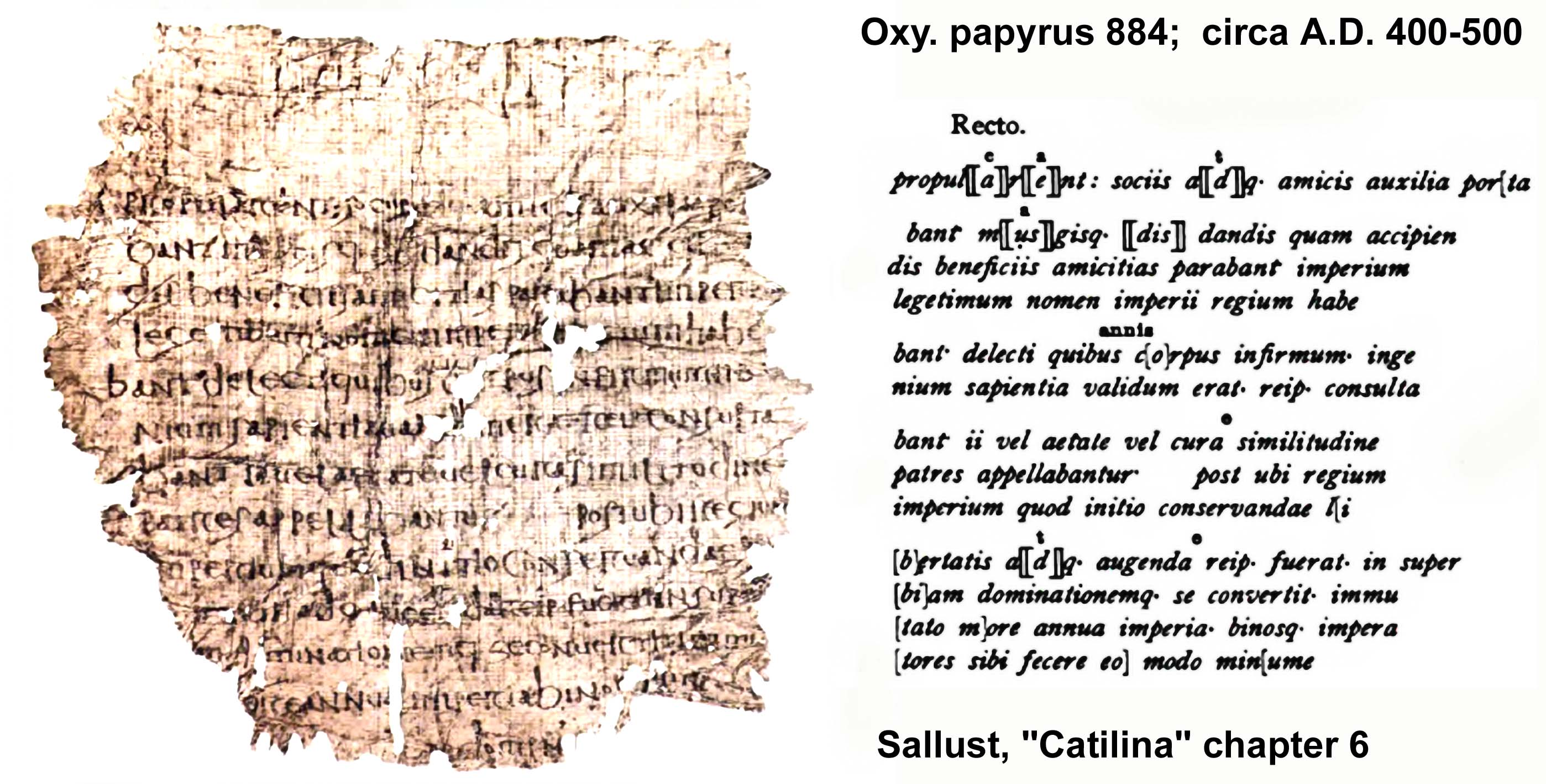
The fact that several of the manuscripts of Sallust's works are as old as the 9th century is very good. The fact that there are also some older ones known, even if they are just scraps, is exceptional. It's good from a point of view of the manuscripts as objects from the 9th century of historical interest in their own right, and it's also good on the general assumption that the older a manuscript is, the greater the chances are that it preserves the original text, that which Sallust actually wrote, with some sort of accuracy. That's a very general assumption. We don't generally know, for any given manuscripts of an ancient text, how many copies may lie between it and the original. A 4th-century papyrus may be a very sloppy copy of a very sloppy copy of a very sloppy copy... repeat many more times, of the original. On the other hand, a 15th century manuscript may be a very accurate copy of a very much older manuscript which was copied from Sallust's own personal copy. Manuscripts are judged on other criteria than age. But generally speaking, for those interested in accurately reconstructing the original text of an ancient author, when it comes to manuscripts, old is good and very old is very good.
And with very few exceptions, until the last couple of centuries, 9th century was about as old as any surviving manuscripts of pre-Christian Classical authors were. This is one of the main reasons why so many scholars point to the reign of Charlemagne as the end of the Dark Ages: because he instituted an educational program, including the study of those ancient pagans, and many of those 9th-century copies were made because of him. So why don't we have many of the copies from which the 9th-century copies were made? Because, before the Italian Renaissance in the 14th century, it rarely seems to have occurred to anyone in Western Europe that a manuscript -- or a building or anything else -- might be worth preserving simply because it was old. New copies were made, and the old, worn-out ones were thrown out. Some of those pre-9th-century exceptions include 8 4th and 5th century manuscripts of Vergil, and 4 5th century manuscripts of Livy -- at least 4. I know of 4, in addition to some of the papyri described below.
Many more older manuscripts have been found by archaeologists from the 19th century onward, written on papyrus and buried in the desert south and east of the Mediterranean, where, it turns out, papyrus can last for a very, very long time without decomposing. By far the most famous of these finds has been the Dead Sea Scrolls, but that discovery was just one of many. Most of the finds have just been scraps, like the papyrus of Sallust illustrated above, but still, because of their age, they're very exciting to students of ancient literature.
Here's a fragment of the Gospel of John, believed to have been copied out in the first half of the 2nd century, very close to the time that this text was originally written:

Speaking strictly as a layman, let that be perfectly clear, the general impression I get from the comparisons of these discoveries of old papyri with medieval manuscripts and with modern editions of ancient texts is that the medieval scribes tended to be very scrupulous and accurate and that the modern editors tend to be very good at their jobs. I know I could never do what they have done, and I'm very grateful for their efforts.
Subscribe to:
Posts (Atom)