Many of the best-known ancient literary works in Greek and Latin, scholars now agree, have long been presented as the work of authors who did not write them.
Gradually, the findings of scholarship about ancient literature make their way toward the consciousness of the general public in the West. The findings about one ancient compilation, about which the West is particularly obsessed, make their way more quickly than all others to the public, and to wider circles of the public: those having to do with the Greek New Testament. If someone believes that all 13 of the books of the New Testament traditionally attributed to St Paul were actually written by Paul, it may come as a shock to learn that scholars now believe that Ephesians, First and Second Timothy and Titus were written by someone else, and that the authorship of Colossians and Second Thessalonians is debated.
This is less shocking for those who have a broad knowledge of ancient Greek and Latin literature, because, among the ancient "pagan" authors, such forgeries are quite common. Take the case of Homer -- well, Homer is a special case to begin with, because there is absolutely no agreement among scholars about whether a writer named Homer ever existed, or whether, if this writer did exist, he wrote the Iliad or the Odyssey or both -- however, it is almost universally agreed now that, whoever wrote the Iliad and the Odyssey, the works known as the Homeric Hymns, and attributed to Homer by the time of Thucydides at the latest, were written by someone else.
No one doubts that Plato existed, or that he wrote many philosophical works centering around Socrates -- but he didn't write all of the dialogues he was once thought to have written. In the collection traditionally thought of as the work of Plato, First Alcibiades, Clitophon, Menexenus and the Epistles are now controversial as to whether or not Plato wrote them, while Second Alcibiades, Epinomis, Hipparchus, Minos, Amatores and Theages are all now generally agreed to have been written by someone else. That's a total ten of the thirty-six works traditionally attributed to Plato, and this does not count nine more works attributed to Plato which were already seen in antiquity to have been spurious: Axiochus, Definitions, Demodocus, Epigrams, Eryxias, Halcyon, On Justice, On Virtue and Sisyphus.
Vergil, on the strength of his works the Aeneid, the Georgics and the Eclogues, is considered by many to be the finest poet ever to have written in Latin. For a long time, an additional collection of poems, the Appendix Vergiliana, were thought to have been poems Vergil wrote in his youth. Now almost no-one believes that Vergil wrote them.
Julius Caesar wrote commentaries about his experiences leading Roman troops in the Gallic and Civil wars. Many editions of Caesar's work have also included commentaries on the Alexandrine, African and Iberian wars, originally presented as works by Caesars, now considered not to have been written by him.
Sallust, an historian and contemporary of Caesar's, is known for works on the Catiline and the Jugurthan War. Editions of his work also contain letters which he ostensibly wrote to Caesar, and a speech against Cicero and one by Cicero against him, which are considered to be forgeries.
An enormous amount of prose survives which was written by Cicero, whom many have called the greatest of all Latin authors. Collections of his works have also included Rhetorica ad Herennium and Commentariolum Petitionis, both almost certainly written by someone other than him.
Ovid is one of the most beloved ancient Latin authors, known for several humorous volumes of what today might be called dating advice, as well as for the Metamorphoses, an extraordinary re-telling of many traditional myths, and the Fasti, a book on Roman holidays which is better than you might think a book on Roman holidays could possibly be, and for other works. Additionally, several works not written by him have circulated along with his works: Consolatio ad Liviam, Halieutica, Nux and Somnium.
There are many, many further examples. Many of these works continue to be of great interest to Classical or biblical scholars, for one reason and another, even after they have been shown to be fakes. One is almost tempted to say that no Classical author can be considered truly great before a spurious work has attached itself to his or her oeuvre.
The authors of such spurious works are often referred to by putting the prefix "pseudo-" in front of the name of the author who is being imitated. More and more, separate editions are dedicated to the work of the forgers, rather than including them in the editions of the forged authors as a sort of afterthought.
Perhaps, as these widespread, and often well-respected forgeries become better-known, the shock of the layman at things like pseudo-Pauline epistles will become somewhat less.
Showing posts with label sallust. Show all posts
Thursday, January 17, 2019
Wednesday, August 31, 2016
C SALLVSTI CRISPI BELLVM CATILINAE, I & III
Omnis homines, qui sese student praestare ceteris animalibus, summa ope niti decet, ne vitam silentio transeant veluti pecora, quae natura prona atque ventri oboedientia finxit. Sed nostra omnis vis in animo et corpore sita est: animi imperio, corporis servitio magis utimur; alterum nobis cum dis, alterum cum beluis commune est. Quo mihi rectius videtur ingeni quam virium opibus gloriam quaerere et, quoniam vita ipsa, qua fruimur, brevis est, memoriam nostri quam maxume longam efficere. Nam divitiarum et formae gloria fluxa atque fragilis est, virtus clara aeternaque habetur[...]
Pulchrum est bene facere rei publicae, etiam bene dicere haud absurdum est; vel pace vel bello clarum fieri licet; et qui fecere et qui facta aliorum scripsere, multi laudantur. Ac mihi quidem, tametsi haudquaquam par gloria sequitur scriptorem et actorem rerum, tamen in primis arduum videtur res gestas scribere: primum, quod facta dictis exaequanda sunt; dehinc, quia plerique, quae delicta reprehenderis, malevolentia et invidia dicta putant, ubi de magna virtute atque gloria bonorum memores, quae sibi quisque facilia factu putat, aequo animo accipit, supra ea veluti ficta pro falsis ducit.
Sed ego adulescentulus initio, sicuti plerique, studio ad rem publicam latus sum ibique mihi multa advorsa fuere. Nam pro pudore, pro abstinentia, pro virtute audacia, largitio, avaritia vigebant. Quae tametsi animus aspernabatur insolens malarum artium, tamen inter tanta vitia imbecilla aetas ambitione corrupta tenebatur; ac me, cum ab reliquorum malis moribus dissentirem, nihilo minus honoris cupido eadem, qua ceteros, fama atque invidia vexabat.
Monday, June 8, 2015
Numbers Of Manuscripts Of Some Classical Authors
This in no way resembles any sort of comprehensive list of all known Classical manuscripts. I wish such a list had been gathered conveniently between book covers, and I could just refer you to the title and ISBN.
Maybe such a list exists. I haven't found it yet. What I have found is some running totals of the numbers of manuscripts known for this or that author. I've found some of these figures in volumes I've had for a while. They've often been hiding in plain sight in the footnotes, where I only recently thought to look.
In A Companion to Homer, ed by Wace and Stubbings, London: MacMillan, 1962, on p 229, in the footnotes to JA Davison's chapter "The Transmission of the Text," we learn that TW Allen had listed 190 medieval and post-medieval manuscripts of the Iliad in his 1931 edition, including 7 which also include the Odyssey, that Allen had listed 75 manuscripts of the Odyssey in volume V of the Papers of the British School at Rome, including those 7 already mentioned, for a total of 258 medieval and post-medieval manuscripts of Homer. Davison' notes also mention ancient manuscripts of Homer listed in RA Pack, Greek and Latin Litrerary Texts from Graeco-Roman Egypt, published in 1952: 381 manuscripts of the Iliad and 111 for the Odyssey. That adds up to a nice round total of 750 manuscripts of Homer. Davison points out that these figures do not include quotations of Homer in the works of other authors, nor indirect sources.
And remember, this was in 1962. I would imagine that more Homeric manuscripts have come to light since then. How many more? I dunno. Can I provide an example of even one specific discovery made since 1962? Strangely, I cannot. There's a ton of stuff online about Homeric manuscripts in general and Homeric papyri in particular, and from my personal point of view, none of it is user-friendly.
In Die Platonhandschriften Und Ihre Gegenseitigen Beziehungen by Martin Wohlrab, published in 1887 in Leipzig by Teubner, page 643, Wohlrab says that his survey includes 147 manuscripts. (This Teubner volume is a reprint from an academic journal, and begins on page 643.) Also on p 643 Wohlrab said that surely many more manuscripts of Plato would be found. This was before the Oxyrhynchus excavations began. How many papyrii of Plato have been found at Oxyrhynchus? And down the road at Fayum? I dunno. Lots, I would imagine. But Wohlrab was talking about manuscripts laying around in libraries which hadn't yet been catalogued. Was he right, in the 1880, when he predicted that many more manuscripts of Plato would be found in libraries? I dunno. I would guess he was right.
In Texts and Transmission, ed by LD Reynolds, Oxford, 1983, on page xxvii, Reynolds counts up some surviving manuscripts of Sallust: 2 from the 9th century, 4 from the 10th, 33 from the 11th, 58 from the 12th, 39 from the 13th, 46 from the 14th and 330 from the 15th, for a total of 482, and adds in a footnote: "The figures are incomplete, especially for the later period." In addition to these medieval manuscripts of Sallust, there are 4 ancient papyrii. 486, but "the figures are incomplete."
On p 36 of Texts and Transmission, Michael Winterbottom mentions 162 recent and unimportant manuscripts of Caesar. I was unable to find a figure which included both the unimportant and the important manuscripts.
On p 412 of Texts and Transmission, Michael Reeve informs us that we have over 650 manuscripts of Terence and adds, "Published estimates stop at 450. I owe the new figure to Claudia Villa."
On p 394, Reeve mentions "over 160 manuscripts" of Statius' Thebiad. Just of the Thebiad. The total number of manuscripts of Statius is more. How many more? I dunno.
I don't know how many manuscripts there are of Cicero. I don't want to know. I'm not a fan. (There are lots and lots.)
And one more time for Reeve: on p 107 of Studies in Latin Literature and its Tradition: in Honour of C O Brink, Cambridge, 1989, he counts up 154 of the 3rd decade of Livy. That's just for the 3rd decade (books 21-30). The total number of Livy manuscripts is somewhat more. How many more? I dunno.
On p vi of his 2004 Oxford edition of Ovid's Metamorphoses, RJ Tarrant informs us that we have over 400 manuscripts of that poem. How many manuscripts do we have of all of Ovid's works? I dunno. Very many, I would imagine.
Saturday, August 13, 2011
Monday, July 5, 2010
Textual Transmission
The transmission of a text is the process by which it goes from the original writing of the author to the reader. In the case of a letter written today, usually the reader has before him the exact version written by the author. On an Internet forum or message board, a moderator may change something in the original text before it is presented to the reader, putting one more step between author and reader.
In the case of older texts, written in ancient or medieval times, things may be more complicated, many more steps may be involved. In other words: the transmission may be much more complicated.
Scholars have found some of the original copies of personal letters and shopping lists and written instructions from an employer to an employee, things like that, from the Middle Ages and some even from before. For example, this letter, one of thousands of pieces of ancient papyrus unearthed at the site of the ancient city of Oxyrhynchus in Egypt, has been dated to the 2nd century AD:

It has been translated as follows:
Thais to her own Tigrius, greeting.
I wrote to Apolinarius to come to Petne for the measuring. Apolinarius will tell you how the situation stands concerning the deposits and public dues. He will let you know the name of the person involved.
If you come, take out six measures of vegetable seed and seal them in the sacks, so that they may be ready. And if you can, please go up and find out about the donkey.
Sarapodora and Sabinus salute you. Do not sell the young pigs without consulting me. Good bye.
Not an earthshaking communication, perhaps, but if one examines a lot of such documents, together they may be very helpful in forming a mental picture of past places and times.
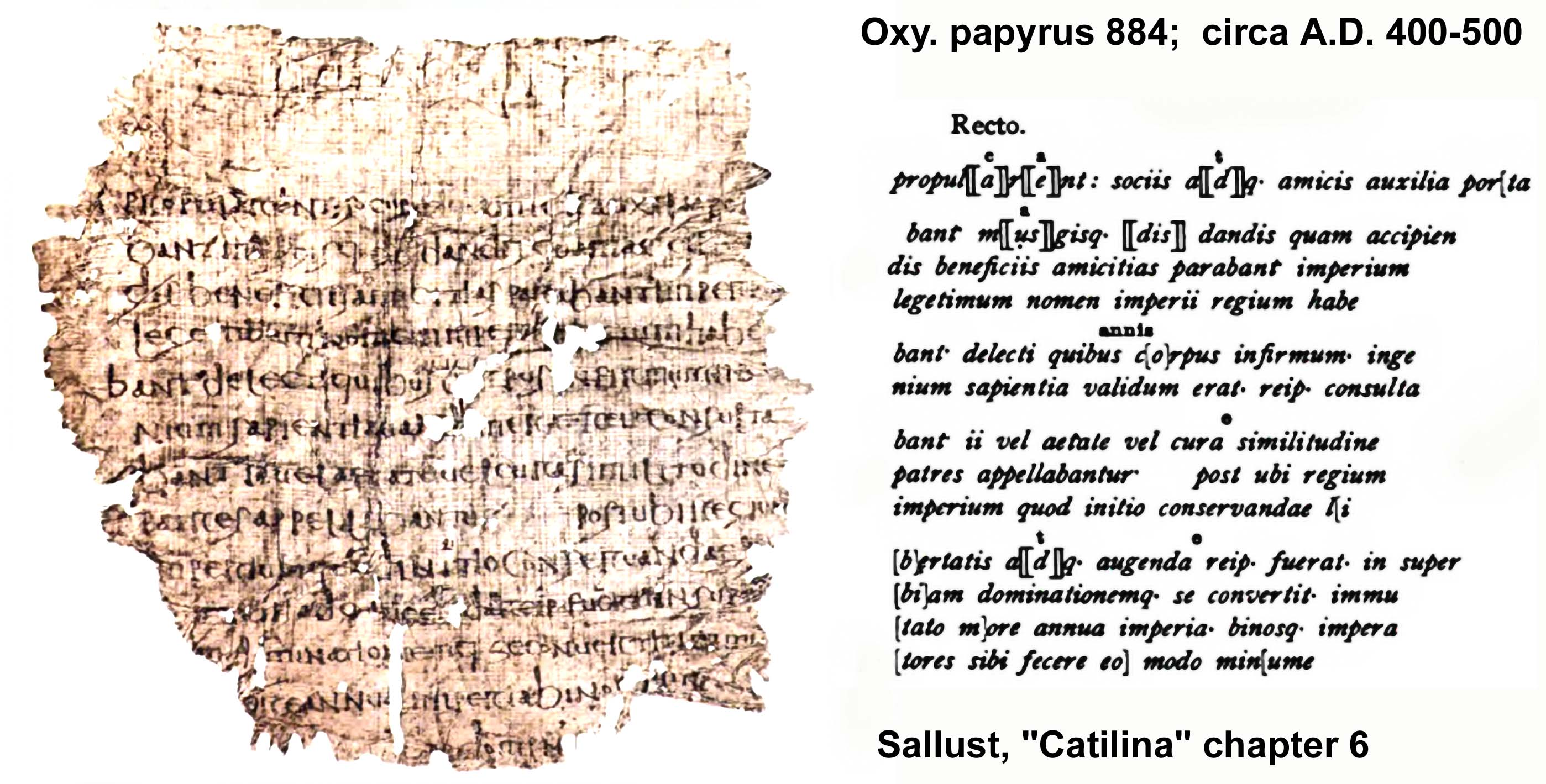
Then there are the texts referred to as "literary," intended for a larger audience: besides the genres we may think of as "literature" in a narrower sense, fiction and poetry and drama, these include works of history and philosophy and science. There's just one copy, from before the age of mechanical and electronic reproduction, of Thaius' letter to Tigrius, presumably either written in Thaius' own hand or dictated to a servant. There may be many copies of a given ancient literary text, but it's rare to find one made within even several centuries of its original composition. For example, as I recently found out, in the case of Sallust' histories of the Cataline conspiracy and the Jugurthine War, written in the 1st century BC, there appear to be over 500 manuscripts in publicly-accessible collections today. But apart from 4 fragments preserved in scraps of papyrus from the 4th and 5th centuries, none of these manuscripts is older than the 9th century. Here's the left edge of one of those papyri:

The fact that several of the manuscripts of Sallust's works are as old as the 9th century is very good. The fact that there are also some older ones known, even if they are just scraps, is exceptional. It's good from a point of view of the manuscripts as objects from the 9th century of historical interest in their own right, and it's also good on the general assumption that the older a manuscript is, the greater the chances are that it preserves the original text, that which Sallust actually wrote, with some sort of accuracy. That's a very general assumption. We don't generally know, for any given manuscripts of an ancient text, how many copies may lie between it and the original. A 4th-century papyrus may be a very sloppy copy of a very sloppy copy of a very sloppy copy... repeat many more times, of the original. On the other hand, a 15th century manuscript may be a very accurate copy of a very much older manuscript which was copied from Sallust's own personal copy. Manuscripts are judged on other criteria than age. But generally speaking, for those interested in accurately reconstructing the original text of an ancient author, when it comes to manuscripts, old is good and very old is very good.
And with very few exceptions, until the last couple of centuries, 9th century was about as old as any surviving manuscripts of pre-Christian Classical authors were. This is one of the main reasons why so many scholars point to the reign of Charlemagne as the end of the Dark Ages: because he instituted an educational program, including the study of those ancient pagans, and many of those 9th-century copies were made because of him. So why don't we have many of the copies from which the 9th-century copies were made? Because, before the Italian Renaissance in the 14th century, it rarely seems to have occurred to anyone in Western Europe that a manuscript -- or a building or anything else -- might be worth preserving simply because it was old. New copies were made, and the old, worn-out ones were thrown out. Some of those pre-9th-century exceptions include 8 4th and 5th century manuscripts of Vergil, and 4 5th century manuscripts of Livy -- at least 4. I know of 4, in addition to some of the papyri described below.
Many more older manuscripts have been found by archaeologists from the 19th century onward, written on papyrus and buried in the desert south and east of the Mediterranean, where, it turns out, papyrus can last for a very, very long time without decomposing. By far the most famous of these finds has been the Dead Sea Scrolls, but that discovery was just one of many. Most of the finds have just been scraps, like the papyrus of Sallust illustrated above, but still, because of their age, they're very exciting to students of ancient literature.
Here's a fragment of the Gospel of John, believed to have been copied out in the first half of the 2nd century, very close to the time that this text was originally written:

Speaking strictly as a layman, let that be perfectly clear, the general impression I get from the comparisons of these discoveries of old papyri with medieval manuscripts and with modern editions of ancient texts is that the medieval scribes tended to be very scrupulous and accurate and that the modern editors tend to be very good at their jobs. I know I could never do what they have done, and I'm very grateful for their efforts.
In the case of older texts, written in ancient or medieval times, things may be more complicated, many more steps may be involved. In other words: the transmission may be much more complicated.
Scholars have found some of the original copies of personal letters and shopping lists and written instructions from an employer to an employee, things like that, from the Middle Ages and some even from before. For example, this letter, one of thousands of pieces of ancient papyrus unearthed at the site of the ancient city of Oxyrhynchus in Egypt, has been dated to the 2nd century AD:
It has been translated as follows:
Thais to her own Tigrius, greeting.
I wrote to Apolinarius to come to Petne for the measuring. Apolinarius will tell you how the situation stands concerning the deposits and public dues. He will let you know the name of the person involved.
If you come, take out six measures of vegetable seed and seal them in the sacks, so that they may be ready. And if you can, please go up and find out about the donkey.
Sarapodora and Sabinus salute you. Do not sell the young pigs without consulting me. Good bye.
Not an earthshaking communication, perhaps, but if one examines a lot of such documents, together they may be very helpful in forming a mental picture of past places and times.
Then there are the texts referred to as "literary," intended for a larger audience: besides the genres we may think of as "literature" in a narrower sense, fiction and poetry and drama, these include works of history and philosophy and science. There's just one copy, from before the age of mechanical and electronic reproduction, of Thaius' letter to Tigrius, presumably either written in Thaius' own hand or dictated to a servant. There may be many copies of a given ancient literary text, but it's rare to find one made within even several centuries of its original composition. For example, as I recently found out, in the case of Sallust' histories of the Cataline conspiracy and the Jugurthine War, written in the 1st century BC, there appear to be over 500 manuscripts in publicly-accessible collections today. But apart from 4 fragments preserved in scraps of papyrus from the 4th and 5th centuries, none of these manuscripts is older than the 9th century. Here's the left edge of one of those papyri:
The fact that several of the manuscripts of Sallust's works are as old as the 9th century is very good. The fact that there are also some older ones known, even if they are just scraps, is exceptional. It's good from a point of view of the manuscripts as objects from the 9th century of historical interest in their own right, and it's also good on the general assumption that the older a manuscript is, the greater the chances are that it preserves the original text, that which Sallust actually wrote, with some sort of accuracy. That's a very general assumption. We don't generally know, for any given manuscripts of an ancient text, how many copies may lie between it and the original. A 4th-century papyrus may be a very sloppy copy of a very sloppy copy of a very sloppy copy... repeat many more times, of the original. On the other hand, a 15th century manuscript may be a very accurate copy of a very much older manuscript which was copied from Sallust's own personal copy. Manuscripts are judged on other criteria than age. But generally speaking, for those interested in accurately reconstructing the original text of an ancient author, when it comes to manuscripts, old is good and very old is very good.
And with very few exceptions, until the last couple of centuries, 9th century was about as old as any surviving manuscripts of pre-Christian Classical authors were. This is one of the main reasons why so many scholars point to the reign of Charlemagne as the end of the Dark Ages: because he instituted an educational program, including the study of those ancient pagans, and many of those 9th-century copies were made because of him. So why don't we have many of the copies from which the 9th-century copies were made? Because, before the Italian Renaissance in the 14th century, it rarely seems to have occurred to anyone in Western Europe that a manuscript -- or a building or anything else -- might be worth preserving simply because it was old. New copies were made, and the old, worn-out ones were thrown out. Some of those pre-9th-century exceptions include 8 4th and 5th century manuscripts of Vergil, and 4 5th century manuscripts of Livy -- at least 4. I know of 4, in addition to some of the papyri described below.
Many more older manuscripts have been found by archaeologists from the 19th century onward, written on papyrus and buried in the desert south and east of the Mediterranean, where, it turns out, papyrus can last for a very, very long time without decomposing. By far the most famous of these finds has been the Dead Sea Scrolls, but that discovery was just one of many. Most of the finds have just been scraps, like the papyrus of Sallust illustrated above, but still, because of their age, they're very exciting to students of ancient literature.
Here's a fragment of the Gospel of John, believed to have been copied out in the first half of the 2nd century, very close to the time that this text was originally written:
Speaking strictly as a layman, let that be perfectly clear, the general impression I get from the comparisons of these discoveries of old papyri with medieval manuscripts and with modern editions of ancient texts is that the medieval scribes tended to be very scrupulous and accurate and that the modern editors tend to be very good at their jobs. I know I could never do what they have done, and I'm very grateful for their efforts.
Saturday, October 24, 2009
New Sensations
(Below, "MS" stands for "manuscript." Not "Microsoft." And "MSS" means "manuscripts.")
Recently for the very first time I read a MS written before the age of printing: a 12th-century MS of Sallust's Cataline Conspiracy and Jugurthian War. Not just looking at a reproduction -- there are many photographs of old MSS on the Internet, and more than a few in the books I've read. Mostly in newer edition of the texts -- and not just looking at a very old book or scroll in a glass case. No, I was allowed to touch this very old book -- very carefully, of course, and every one who examines old MSS such as this is required to wash his or her hands first -- and turn all the pages. The pages were no more than 9 by 6 inches, a large octavio or small quatro, a bit of a surprise. I guess I was used to seeing huge folio volumes in the aforementioned glass cases and in dramatic reenactments of medieval scholarship. I thought perhaps this copy of Sallust might be contained in one of those old backbreakers along with many other texts. But no, the whole book was Sallust. I had also expected the vellum to be much thicker. (It was the first time I had ever touched vellum or parchment.) These pages did not feel thicker than paper. There were 70-some leafs in the volume, and the stack of them was not much thicker than an inch, if that. I don't think the cover was the original one, but that should in no way be confused with an expert opinion. If it's the original cover it's remarkably intact. It's somewhat uneven and lumpy and fashioned from an indeterminate light-colored substance, and along its spine the volume's title is written in a hand resembling that inside.
The handwriting was small, apart from a very ornate and colorful capital o, about an inch in circumference, blue and green and much gold that looked as if it had to be actual gold, beginning Sallust's text. In the margins were many notes in various hands, much too small for me to have been able to read them had I not had a large magnifying glass. Turning the pages, I was reminded that neither the word "bookworm" nor "wormhole" had begun as a figure of speech, that their original meanings were quite literal.
I asked the librarian on duty whether anyone was there who knew a lot about these sorts of MSS. Very soon after starting to examine it I had many questions: Would the condition of this MS be considered good or poor or average compared to that of 12th-century manuscripts generally? Was the amount of marginal notes unusually large? Had this particular MS been used in the making of any editions? The librarian said no, no one expert in that particular field was there at the moment. A little later, however, she very kindly brought to my table a folder of materials, mostly letters, relating to the manuscript; she said I might find some of these items interesting. Oh yes, I did. There was a letter from the 1920's written by the man who owned the MS then, saying that he had received an offer of over $4000 dollars for it, but would rather see it end up in a public collection than in private hands, and was therefore prepared to accept a lower offer from the library. I don't remember the lower figure he suggested, but it was still several thousand dollars. There was a letter from L D Reynolds in Oxford from the 1980's, when he was preparing his edition of Sallust,
asking whether the library could send him a microfilm copy of this MS, and a reply from a librarian who didn't flatly refuse the request, but expressed concern that microfilming might damage the MS. I don't know whether anything was eventually worked out so that Reynolds could see the MS or an image of it, but I have a copy of his edition, published in 1991 by Oxford Classical Texts, and I don't recall any mention of it in his preface or notes.
There was one document from the early 20th or late 19th century, describing the MS as 11th-century, and then another disputing this opinion and advancing very strongly the view that it was written in the 12th-century. I know very little about dating MSS. For now I'm accepting more or less on blind faith that scholars know what they're talking about when they assign dates to MSS. However, I have noticed that many of them, from late antiquity to the High Middle Ages -- between the 3rd and 14th centuries, roughly -- are now dated a century or so later than they were a century ago. This MS is typical of those many in that regard. Look at the siglia in editions of ancient Latin texts made before 1920, and then at editions of the same texts made after 1960, I doubt that you'll have to examine many volumes before you see a manuscript dated a century later after 1960 than it was before 1920. I can't recall a single instance of an old manuscript's generally-accepted date being revised as older. [PS, 15 July 2015: Since writing this post I have seen so many examples of manuscripts' dates being revised as older that I can't say any longer that it seems less common to me than dates being revised as more recent. Nota bene, I am still not be confused with an expert.]
Let us assume that this MS of Sallust really was written in the 12th century, and most of the marginal notes very soon after the body of text, as the catalog and the documents in the folder assert. That is what I was assuming as I was examining it. And very quickly I became quite overwhelmed at the thought. The 12th century, I said to myself. When Baldwin I through Baldwin IV and others were the Kings of Jerusalem. When William of Tyre, tutor of the leprous Baldwin IV, wrote his history of the Crusades.
When Saladin eventually retook Jerusalem for Islam. I neglected to note where the MS had been written. Probably by a monk. Perhaps in Germany or France, or northern Italy. Surely the deeds accomplished beyond the sea, the great battles of Christian against Moslem in the Holy Land, must have been among the great news and excitement of the day. The monk who copied out Sallust's histories of Cataline's conspiracy and of Rome's war against Jugurtha, who began each sentence with a red letter and who painted that lovely ornate capital o at the beginning of Sallust's reports, with blue and green and gold twisting to look like coils of rope inside the o's circle -- was this monk swept up by the excitement about the Crusades? Or was he skeptical, and disturbed by all the bloodshed and fanaticism? (Or was it not a monk who wrote this? Or not a he? Very likely it was either a monk or a nun, it was what a lot of them did and few others at the time did anything of the sort.) If someone felt inwardly distanced from all this Christian fervor -- outwardly expressed distance would have been very reckless -- what could he do but study old grumpy "pagans" such as Sallust? Or perhaps he, or possibly she, was a fervent supporter of the wars in the east, and saw parallels between them and ancient Rome's struggles against the wicked troublemaker Cataline and against the African king Jugurtha?
What would he think of me writing about his MS on this computor, on this website? Was he scientifically inclined, would he be delighted to see such things, quick to grasp how they function, or would he feel nothing but shock and terror, convinced that we were all demons and witches? Will anyone read Steven Runciman 850 years from now? How much will books and means of writing change between now and then? Will Latin finally really be dead? I certainly hope not. No, certainly not. Recently I had an idea for a dystopian movie screenplay, depicting a near future where the study of history will have virtually died out, and no one will be able to read anything written more than a couple of centuries in the past. And where a Quixotic hero puts himself at some risk by inquiring into such things. Perhaps the study of Latin and Greek would actually be banned by the authorities.
It might be fun to write something like that as a satire of certain stupid present tendencies. I don't think we're headed toward such a dystopia. Not all of us, anyway. But then again, I live near the campus of one of the greatest universities in the world, which may make me overly optimistic.
Recently for the very first time I read a MS written before the age of printing: a 12th-century MS of Sallust's Cataline Conspiracy and Jugurthian War. Not just looking at a reproduction -- there are many photographs of old MSS on the Internet, and more than a few in the books I've read. Mostly in newer edition of the texts -- and not just looking at a very old book or scroll in a glass case. No, I was allowed to touch this very old book -- very carefully, of course, and every one who examines old MSS such as this is required to wash his or her hands first -- and turn all the pages. The pages were no more than 9 by 6 inches, a large octavio or small quatro, a bit of a surprise. I guess I was used to seeing huge folio volumes in the aforementioned glass cases and in dramatic reenactments of medieval scholarship. I thought perhaps this copy of Sallust might be contained in one of those old backbreakers along with many other texts. But no, the whole book was Sallust. I had also expected the vellum to be much thicker. (It was the first time I had ever touched vellum or parchment.) These pages did not feel thicker than paper. There were 70-some leafs in the volume, and the stack of them was not much thicker than an inch, if that. I don't think the cover was the original one, but that should in no way be confused with an expert opinion. If it's the original cover it's remarkably intact. It's somewhat uneven and lumpy and fashioned from an indeterminate light-colored substance, and along its spine the volume's title is written in a hand resembling that inside.
The handwriting was small, apart from a very ornate and colorful capital o, about an inch in circumference, blue and green and much gold that looked as if it had to be actual gold, beginning Sallust's text. In the margins were many notes in various hands, much too small for me to have been able to read them had I not had a large magnifying glass. Turning the pages, I was reminded that neither the word "bookworm" nor "wormhole" had begun as a figure of speech, that their original meanings were quite literal.
I asked the librarian on duty whether anyone was there who knew a lot about these sorts of MSS. Very soon after starting to examine it I had many questions: Would the condition of this MS be considered good or poor or average compared to that of 12th-century manuscripts generally? Was the amount of marginal notes unusually large? Had this particular MS been used in the making of any editions? The librarian said no, no one expert in that particular field was there at the moment. A little later, however, she very kindly brought to my table a folder of materials, mostly letters, relating to the manuscript; she said I might find some of these items interesting. Oh yes, I did. There was a letter from the 1920's written by the man who owned the MS then, saying that he had received an offer of over $4000 dollars for it, but would rather see it end up in a public collection than in private hands, and was therefore prepared to accept a lower offer from the library. I don't remember the lower figure he suggested, but it was still several thousand dollars. There was a letter from L D Reynolds in Oxford from the 1980's, when he was preparing his edition of Sallust,
There was one document from the early 20th or late 19th century, describing the MS as 11th-century, and then another disputing this opinion and advancing very strongly the view that it was written in the 12th-century. I know very little about dating MSS. For now I'm accepting more or less on blind faith that scholars know what they're talking about when they assign dates to MSS. However, I have noticed that many of them, from late antiquity to the High Middle Ages -- between the 3rd and 14th centuries, roughly -- are now dated a century or so later than they were a century ago. This MS is typical of those many in that regard. Look at the siglia in editions of ancient Latin texts made before 1920, and then at editions of the same texts made after 1960, I doubt that you'll have to examine many volumes before you see a manuscript dated a century later after 1960 than it was before 1920. I can't recall a single instance of an old manuscript's generally-accepted date being revised as older. [PS, 15 July 2015: Since writing this post I have seen so many examples of manuscripts' dates being revised as older that I can't say any longer that it seems less common to me than dates being revised as more recent. Nota bene, I am still not be confused with an expert.]
Let us assume that this MS of Sallust really was written in the 12th century, and most of the marginal notes very soon after the body of text, as the catalog and the documents in the folder assert. That is what I was assuming as I was examining it. And very quickly I became quite overwhelmed at the thought. The 12th century, I said to myself. When Baldwin I through Baldwin IV and others were the Kings of Jerusalem. When William of Tyre, tutor of the leprous Baldwin IV, wrote his history of the Crusades.
What would he think of me writing about his MS on this computor, on this website? Was he scientifically inclined, would he be delighted to see such things, quick to grasp how they function, or would he feel nothing but shock and terror, convinced that we were all demons and witches? Will anyone read Steven Runciman 850 years from now? How much will books and means of writing change between now and then? Will Latin finally really be dead? I certainly hope not. No, certainly not. Recently I had an idea for a dystopian movie screenplay, depicting a near future where the study of history will have virtually died out, and no one will be able to read anything written more than a couple of centuries in the past. And where a Quixotic hero puts himself at some risk by inquiring into such things. Perhaps the study of Latin and Greek would actually be banned by the authorities.
It might be fun to write something like that as a satire of certain stupid present tendencies. I don't think we're headed toward such a dystopia. Not all of us, anyway. But then again, I live near the campus of one of the greatest universities in the world, which may make me overly optimistic.
Subscribe to:
Posts (Atom)